The Hidden Language of Emoji Pairs in Your Social Media Comments

Jan 23,2026
You're scrolling through your feed, and you see a friend's post about their new job. You want to comment something supportive, but just 'Congratulations!' feels a bit flat. So, you add a couple of emojis. Maybe the party popper and the clapping hands. It feels right. But what if you swapped them? Would it feel the same?
This tiny, almost unconscious choice is where the magic happens. In the fast-paced world of social media comments, we're not just sending words; we're sending micro-expressions. And when we combine emojis, we're writing a subtle, visual sentence that our friends read in a heartbeat.
Think about the classic heart-eyes emoji followed by the fire emoji. It screams 'I am obsessed, this is amazing!' It's intense admiration. Now, picture it the other way: fire, then heart-eyes. It still shows love for something cool, but the emphasis shifts. It feels more like 'This is awesome... and I also really love it.' The lead emoji sets the stage.
The order acts like a filter for our intent. A crying-laughing face followed by a heart can feel like 'This is so funny, I love you for posting it.' It's joyful and affectionate. But a heart followed by the crying-laughing face? That can come across as 'I love you... you're such a goofball.' The primary emotion stated first colors everything that follows.
This isn't about hard rules. It's about the natural flow of emotion as we type. When we're genuinely reacting, our first instinct often dictates the first emoji. That initial burst of feeling—whether it's laughter, shock, or love—gets the prime spot. The second emoji then modifies or deepens that initial reaction.
It's fascinating to see this play out in comment sections. Under a breathtaking travel photo, you might see a stream of '😍🔥' comments. The awe (heart-eyes) comes first, then the affirmation of its coolness (fire). It creates a collective, understood language among viewers.
For more on how these combinations are reshaping our chats, check out this piece on how emoji combinations are changing digital conversations.
When the Order Tells a Different Story
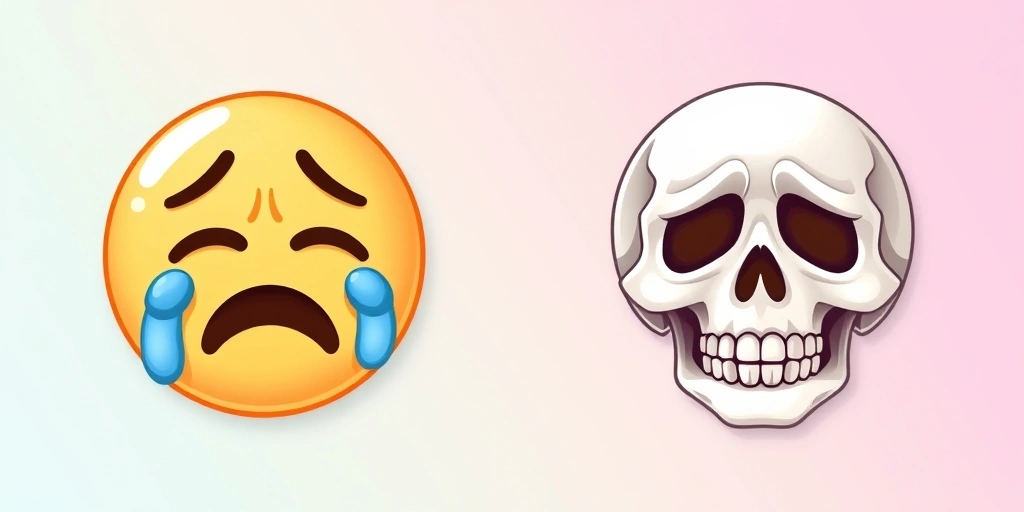
Sometimes, swapping two emojis doesn't just soften the meaning—it can flip it. Consider the skull emoji and the crying face. Skull then crying often reads as 'I'm dead from laughter, and now I'm sad it's over' or a dramatic 'This killed me, woe is me.' It's usually still humorous.
But crying face then skull? The primary emotion is sadness or distress, intensified by the 'death' of the skull. It can feel much heavier, like 'This is so sad it's destroying me.' The context of the post is everything, but that leading emotion is a powerful cue.
This subtlety is why emoji pairs are so powerful in comments. We have limited space and time. We can't write a paragraph explaining our nuanced feelings about a meme or a baby photo. But with two well-chosen emojis in the right sequence, we can convey a complex, layered reaction instantly.
It turns our comments from simple statements into rich, emotional responses. We're not just 'liking' something; we're sharing in the specific flavor of the moment—the hilarious absurdity, the proud excitement, the sympathetic 'ouch.'
The Unspoken Etiquette of Pairs
There's an unspoken etiquette developing, too. On a post about someone's personal loss, a single heart or praying hands is standard. Adding a second emoji, like a heart after the praying hands, can feel like a more personal, layered gesture of care. But the wrong pair, or a jarring order, can feel off-tone, even if the individual emojis are sympathetic.
We're constantly, intuitively learning this language. We see how others react and mimic the patterns that feel right. We develop a sense for when '😢❤️' (sadness then love) is more appropriate than '❤️😢' (love then sadness) on a friend's venting post.
This exploration of pairs is a big part of what makes modern messaging so dynamic. If you're curious about using these combinations more intentionally in your daily chats, you might find this article on emoji combinations as a conversation hack really interesting.
So next time you're about to hit 'comment,' pause for a half-second on your emoji pair. Think about the story you want to tell. Are you leading with laughter and following with love? Or leading with shock and following with laughter? That tiny sequence is your voice, your tone, your little digital nudge. It’s how we add a human touch, one visual cue at a time, making the vastness of a social media feed feel a little more like a conversation.
For more thoughts on this and other emoji trends, the emoji combinations category on our blog is always being updated.
📒 Related Blogs
More...The Secret Life of Emojis: How Our Digital Heartbeats Mirror a Changing World
Navigating Tricky Texts: How Emojis Become Your Emotional Lifeline in Group Chats
Beyond Likes: How Emojis Revolutionize Social Media Engagement & Marketing
Emoji Psychology: Unpacking What Your Favorite Emojis Reveal About You
The Unseen Clarity: How Emojis Save Our Private Conversations
Emoji Evolution: From Simple Pixels to Global Pop Culture Icons