The Quiet Comfort: How Emojis Speak Volumes When Words Fail

Dec 28,2025
We’ve all been there, right? Staring at a blinking cursor, trying to craft a message that perfectly captures what’s swirling inside us. It’s even harder when you’re navigating something a bit delicate, a little uncertain, or just plain hard to articulate. In those private moments, when a simple text exchange can feel like walking on eggshells, I've noticed how emojis silently step in, becoming the unsung heroes of emotional clarity.
It’s not about avoiding honest conversations, not at all. It’s about creating a softer landing for them, a gentle preamble. Sometimes, the full weight of an emotion feels too heavy to put into explicit words right away. You might not even fully understand it yourself. Maybe you’re feeling a mix of apprehension and hope, or a flicker of disappointment mixed with understanding. How do you type that out without sounding confusing or overwhelming?
The Subtle Art of the Unspoken
I think the real magic of emojis in these situations is their ability to convey nuance without demanding a detailed explanation. A simple 😬 can say, "I'm a bit nervous about this, but I'm going with it," or "Oops, that was awkward," without you having to type out an entire paragraph of internal monologue. It’s an instant emotional shorthand that respects both the sender's internal state and the receiver's capacity to understand without extensive deciphering.
Consider the 🫠 emoji, for example. It’s the melting face. It doesn't mean you're literally melting, but it powerfully communicates a feeling of being overwhelmed, embarrassed, or just completely done in a charming, almost self-deprecating way. Using it allows you to express a feeling that might otherwise take several sentences to explain, preserving the flow of a casual chat while still being emotionally honest.
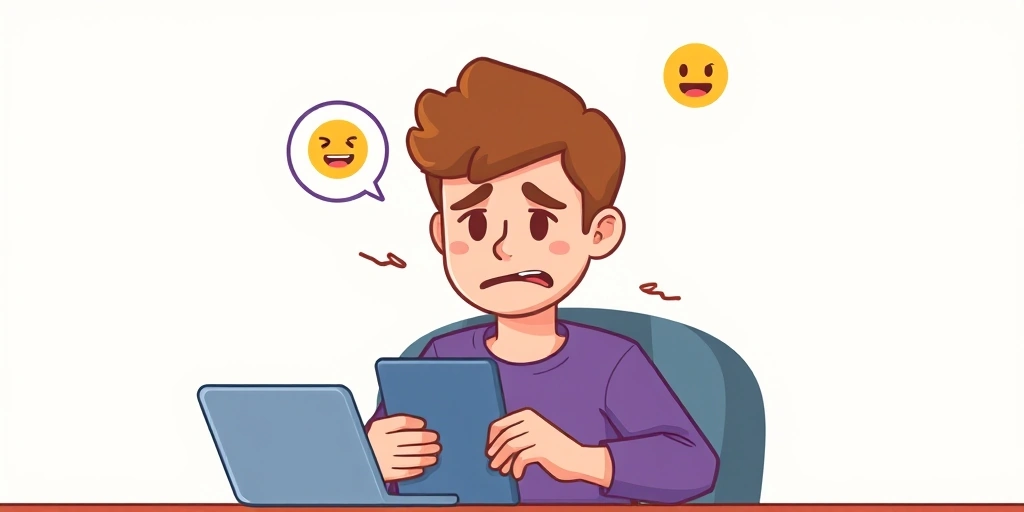
And what about when you’re not sure how someone will react? You send a message, and then add a 😅 or a 🫣. These aren't just decorative; they're tiny apologies, pre-emptive deflections, or even just a way to say, "I'm a little vulnerable sending this." They signal that you’re aware of the potential emotional landscape and you’re approaching it with a touch of caution and good humor. This is particularly true in private chats where the stakes might feel higher because of the intimacy of the relationship. It's an interesting part of how we navigate emoji & situation in our daily lives.
When Words Feel Too Permanent
There are moments when words feel too definitive, too set in stone. When you’re uncertain about a situation or a feeling, committing it to text can feel like solidifying something that’s still fluid. Emojis offer a temporary, almost ethereal way to express these nascent emotions. A 🤔 after a statement can signal contemplation rather than confusion, inviting a soft follow-up instead of a hard question. It keeps the door open for exploration rather than closing it with a definitive, possibly incorrect, statement.
I’ve found this especially useful when dealing with minor disagreements or misunderstandings. Instead of a terse "Okay," which can sound passive-aggressive, an "Okay 👍" or "Okay 🙂" clarifies that there's no underlying negative emotion, even if the situation itself isn't ideal. The visual cue softens the blow, making the exchange smoother and less prone to misinterpretation.
Bridging Emotional Gaps with a Single Tap
Think about receiving news that leaves you feeling… well, something you can’t quite name. Maybe it’s not bad, not good, just... ambiguous. Replying with a lengthy paragraph trying to dissect your feelings can be exhausting for both you and the recipient. A simple 😶🌫️ or 🥺 can convey that sense of being a bit overwhelmed or needing a moment, without having to dive into a full emotional breakdown in text. It’s a gentle pause button, an acknowledgment of the moment without demanding an immediate verbal response.
This kind of non-verbal communication is vital because it allows space for emotions to breathe. It acknowledges the complexity of human feelings without forcing them into neat, pre-defined boxes. It’s a way to say, "I'm feeling *something*, and it's a bit much right now, but I'm okay," or "I'm processing this." This saves both parties from the pressure of an immediate, perfect verbal response, making the conversation feel more natural and less performative.

It's about the emotional labor we save ourselves and others. Sometimes, you just don't have the energy to explain *why* you're feeling a certain way, or *what* exactly that feeling is. A well-placed emoji acts as a placeholder for that deeper conversation, signaling that while you might not be able to articulate it now, the emotion is real and present. It's a testament to the subtle power of emojis bridging uncomfortable silences, creating a more empathetic digital space.
The Reassurance Factor
Emojis also provide immense reassurance, especially in moments of emotional uncertainty. If you’re checking in on a friend and they reply with a "Feeling a bit down today 🙁," that single emoji adds a layer of genuine vulnerability and immediate understanding that plain text might miss. You instantly grasp the emotional tone and can respond with appropriate empathy, perhaps a "Sending hugs 🤗" or "Hope your day gets better ❤️." It fosters a quicker connection and reduces the potential for misunderstandings.
I've noticed this particularly in planning. When someone is expressing hesitation about plans, instead of having to write out a long justification, a 🤷♀️ or 😬 can convey, "I'm not entirely sure yet," or "I'm feeling a bit torn." It allows for a response like, "No worries, take your time," rather than immediately pressing for details. This reduces pressure and makes interactions feel much lighter and more considerate.
Cultivating Emotional Intelligence Digitally
Using emojis in this way actually cultivates a form of digital emotional intelligence. It teaches us to be more attuned to the non-verbal cues in our text-based interactions. We learn to interpret the subtleties, to read between the lines (or, rather, around the emojis). This skill is invaluable in maintaining healthy digital relationships, preventing miscommunications that can easily arise when tone and body language are absent.
It’s about understanding that communication isn't just the words we choose, but also the feelings we choose to share, even in their most distilled form. Emojis are incredible tools for this, allowing us to express complex human emotions – the 'in-betweens' and the 'not-quite-sures' – without having to commit to a full verbal breakdown. They let us be vulnerable, uncertain, or just plain human, all with a tap of a tiny graphic.
So, the next time you find yourself fumbling for words, wondering how to articulate that knot in your stomach or that flutter of hope, remember the power of the emoji. It’s often the quietest voice in the room that speaks the loudest, making our private conversations richer, more empathetic, and wonderfully, truly human.
📒 Related Blogs
More...How Emojis Are Revolutionizing Branding & Marketing: A Modern Guide
Decoding the Digital Heartbeat: How Emojis Capture Our Ever-Changing Cultural Moods
The Joy of Play: How Emojis Turn Everyday Chats into a Playground
Beyond Words: How Emojis Shape Our Online Personalities & Digital Identity
When Emojis Take the Pressure Off: The Secret to Truly Relaxed Messaging
Emojis in Business: Enhancing Professional Communication & Brand Building