The Secret Power of Emojis: Your Brain's Favorite Shortcut

Mar 25,2026
Think about the last text you sent. Chances are, it included an emoji. That little thumbs-up, crying-laughing face, or red heart wasn't just a decorative add-on. It was doing serious work. In the fast-paced world of digital chat, emojis have become our brain's go-to tool for speed and understanding.
When we talk face-to-face, we have a whole symphony of cues to help us: tone of voice, facial expressions, gestures. A simple "okay" can mean genuine agreement, sarcastic resignation, or hesitant acceptance, all depending on how it's said. Strip that away, and you're left with plain text—a landscape that's famously easy to misinterpret.
This is where the magic of the emoji shortcut happens. Our brains are wired for efficiency. They love patterns and quick associations. An emoji acts like a pre-packaged bundle of emotional and contextual information. When you see a 😂, your brain doesn't have to slowly deduce "this person finds this hilarious." It instantly recognizes the symbol for extreme laughter. It's a cognitive leap, bypassing lengthy interpretation.
From Ambiguity to Instant Clarity
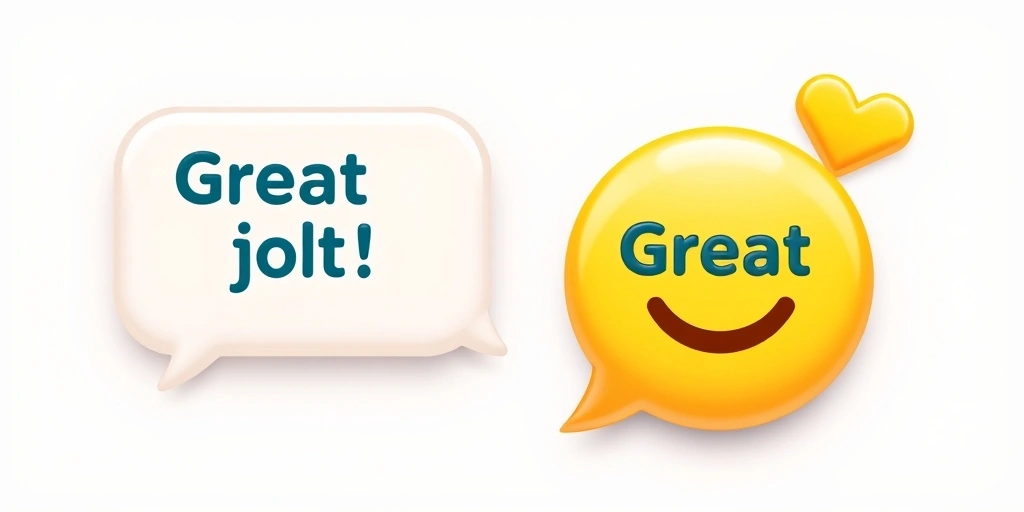
Consider the sentence "Great job." On its own, it's painfully ambiguous. Is it sincere praise from your boss? Is it your friend being sarcastic after you spilled coffee? Add a 🎉 or a 🙄, and the intended meaning snaps into focus immediately. The emoji resolves the ambiguity, acting as a tonal anchor for the entire message.
This function is crucial because our digital conversations are often asynchronous and lack the immediate feedback loop of real-time talk. We can't see the other person's reaction to correct ourselves. By using an emoji, we're proactively guiding the recipient's interpretation, reducing the mental load on both ends. It's a way of saying, "Here's the emotional lens to view this text through." For more on how emojis prevent misunderstandings, you might find this article on clearing up text message confusion interesting.
The Efficiency of Visual Language
Emojis are a form of visual language, and the brain processes images faster than it processes words. Reading the word "happy" involves decoding letters into sounds and then connecting that to a concept. Seeing a 😊 is a more direct route. The visual symbol connects almost instantly to the associated feeling. This speed is what makes them such effective shortcuts in quick-fire messaging apps and social media feeds.
They also help with memory and recall. A message punctuated with a relevant emoji is often easier to remember than a block of plain text. The image creates a stronger hook in our memory, tying the emotional tone to the content.
More Than Just Decoration
It's easy to dismiss emojis as frivolous, but their role is deeply functional. They fill the emotional gap left by text-based communication. A period can feel cold and final in a message, while ending a sentence with a simple 🙂 can soften it, signaling friendly intent. They allow for nuance and emotional layering that would take many more words to achieve.
This isn't about dumbing down language; it's about evolving it for a new medium. Just as we developed punctuation to add clarity to written sentences, we're adopting emojis to add clarity to digital dialogue. They are the punctuation for emotion in the 21st century.
The psychology behind this is fascinating and worth exploring further. If you're curious about the deeper mental mechanisms at play, the emoji psychology category has a wealth of insights.
So, the next time you tap that heart or fire emoji, know that you're not just making your message prettier. You're engaging in a sophisticated cognitive dance. You're using a powerful mental shortcut to convey warmth, irony, excitement, or support in a way that words alone often struggle to capture. You're helping the person on the other side understand you, quickly and clearly, in a world that moves at the speed of a notification.
📒 Related Blogs
More...How Emojis Became Our Silent, Everyday Conversation
The Hidden Power of Emojis: How a Tiny Icon Can Change Your Message's Meaning
How Emojis Save Us From Those Awkward Texting Silences
The Shifting Faces of Digital Culture: How Emojis Mirror Our Online Worlds
The Secret Language of Emojis: How They Become Our Instant Communication Shortcuts
Emojis in Business: Boost Customer Connection & Branding with Icons