How Emojis Clear Up Confusion in Your Text Messages

Mar 25,2026
Think about the last time you sent a simple 'okay' in a text. Did you mean 'Okay, great!' or 'Okay, I'm annoyed'? Without any other cues, the person on the other end has to guess. This is the core problem of text-based communication: it strips away the tone of voice, facial expressions, and body language that we rely on to understand each other.
This ambiguity is where misunderstandings breed. A sarcastic comment can be taken at face value. A genuine question can sound like an accusation. We've all been there, typing and retyping a message, adding 'lol' or an exclamation point, trying desperately to signal our intent. It's exhausting.
The Missing Piece of the Puzzle
Enter emojis. These small, colorful icons do one job incredibly well: they provide emotional and intentional context. They act as a stand-in for the non-verbal cues we lose when we type. A thumbs up isn't just an agreement; it's a friendly, positive agreement. A face with tears of joy doesn't just mean something is funny; it signals you're laughing with someone, not at them.
Research in communication theory backs this up. Concepts like uncertainty reduction theory suggest that people are motivated to reduce ambiguity in interactions to increase predictability. In face-to-face talks, we do this by reading a person's expression. Online, emojis become a crucial tool for achieving the same clarity.
For example, consider the difference between these two messages:
'You're going to wear that?'
Versus:
'You're going to wear that? 😉'
The first is harsh and judgmental. The second, with the wink, transforms the message into playful teasing among friends. The emoji didn't change the words; it changed the entire frame through which the words are interpreted.
Beyond Just Being 'Friendly'
The power of emojis goes deeper than just making things seem nicer. They help establish the nature of a relationship and set the tone for an entire conversation. Using certain emojis can signal formality, closeness, sarcasm, or support.
In professional settings, a simple smiley at the end of a request ('Can you send me the report by EOD? 🙂') can soften what might otherwise be read as a blunt demand. In personal chats, a heart or a hugging face can convey empathy and support when words alone feel insufficient ('I'm so sorry to hear that 💙').
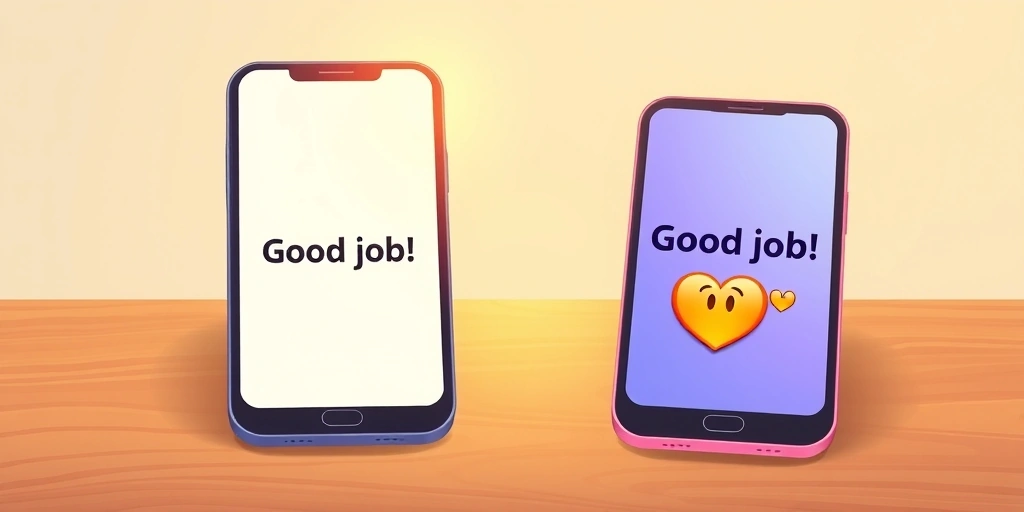
This function is so powerful that it touches on the psychological impact of visual cues on our feelings. Seeing a positive emoji can literally prime our brain to interpret the accompanying text more favorably.
When a Period Isn't Just a Period
Even punctuation isn't safe from ambiguity. For many people, especially in casual digital communication, a period at the end of a single-sentence text can feel passive-aggressive or overly formal. 'Sure.' feels different from 'Sure!'. But what if you just want to end your sentence properly without any emotional subtext? An emoji can resolve that tension. 'Sure 😊' is clear, friendly, and final.
This shows how emojis have evolved to fill very specific gaps in our digital language. They aren't just decorations; they are functional components of meaning.
Of course, emoji use isn't a perfect science. Interpretation can vary by culture, age group, and personal relationship. A skull emoji might mean 'I'm dead from laughter' to one person and signify something much darker to another. But even this potential for misinterpretation is often lower than the risk of misinterpretation with plain text, because the emoji at least signals that there is an emotional or tonal layer to decode.
The goal isn't to create a universal, mistake-proof code. It's to provide more data points—more clues—for the person reading your message. In the complex dance of human connection, especially through a screen, every clue helps. By offering a glimpse of the sender's emotional state, emojis make our digital conversations feel less like sending telegrams into the void and more like having a real, nuanced chat.
For more insights into how these tiny icons shape our interactions, explore other articles in our section on emoji psychology.
📒 Related Blogs
More...The Unsung Heroes of Your Chats: How Emojis Keep the Conversation Alive
Beyond Words: The Subtle Power of Emojis in Navigating Sensitive Conversations
The Secret Language of Emojis: How They Become Our Instant Communication Shortcuts
The Secret Power of Emojis: How a Tiny Icon Can Change Your Message's Meaning
The Unspoken Language: How Emojis Casually Shape Our Daily Chats
The Professional Emoji: How a Simple Smiley Can Change Your Work Message