The Slow Fade: How Emojis Quietly Show Our Disappointment

Jan 26,2026
Think about your closest text threads. The ones with your partner, your best friend, or a family member. At first, the emojis flow freely—hearts, laughing faces, fireworks. They’re the exclamation points of your joy. But sometimes, a shift happens. It’s rarely a dramatic declaration. More often, it’s a slow, almost imperceptible change in the tiny pictures we send.
It might begin with a heart that’s just a shade less red, replaced by a simple yellow one. Or the crying-laughing emoji that once punctuated every joke slowly disappears, leaving behind a plain ‘lol’ that feels hollow. This isn’t about being passive-aggressive (though it can slip into that). It’s about our hearts trying to find a safe way to speak when words feel too heavy or too risky.
Emojis give us a layer of protection. Saying "I’m disappointed in you" is a seismic sentence. It changes the landscape of a relationship. But sending a weary face 😔 or a slightly deflated balloon 🎈 after a cancelled plan? It carries the same emotional weight but feels softer, more manageable. It’s a way of whispering our hurt without having to shout it. We’re not just describing a feeling; we’re offering a visual sigh that the other person has to interpret. This dance of interpretation is where so much of our modern connection—and disconnection—happens. For more on how emojis shape our emotional world, explore our emoji & emotion blog category.
The Timeline of a Fading Smile
Disappointment is often a cumulative emotion. It builds in the gaps between expectations and reality. And our emoji use charts that buildup with startling accuracy.
In the early stages of letdown, you might see the ‘thumbs up’ 👍 replace a more enthusiastic "Amazing! 😍". It’s agreement without endorsement. Approval without warmth. Then, the response times might grow slower, and the replies become shorter. The elaborate stories that once ended with a string of relevant emojis now get a simple "Nice." or a lone smiling face 🙂. That neutral smile is one of the most powerful tools in the digital toolbox. It can mean "I’m fine," "I’m not fine," "I’m listening but not thrilled," or "Let’s just move on." Its ambiguity is its superpower and its curse.
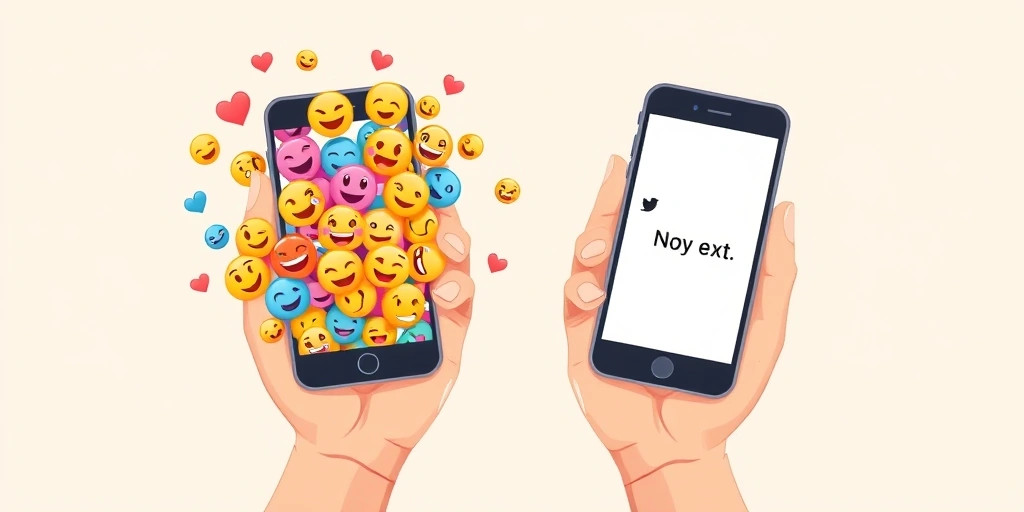
Over time, the emojis might not just change in type, but in energy. The vibrant, animated emojis (like the grinning face with smiling eyes 😄) give way to their static, less intense counterparts (like the slightly smiling face 🙂). It’s a visual cooling. The conversation hasn’t stopped, but the emotional voltage has been dialed down. This is closely related to how emojis whisper our anticipation, where the buildup of hope is also silently communicated.
When the Emojis Disappear Altogether
The most potent signal can be absence. When a thread that was once a colorful tapestry of icons becomes a wall of gray text, the message is clear. The effort to decorate, to add emotional subtext, has faded. The words now have to stand completely on their own, and without that emoji cushion, they can feel colder, more formal, more distant. It’s in this space that small misunderstandings can grow into real rifts, because the clarifying, tone-setting visual cue is gone.
This isn’t always negative. Sometimes, dropping emojis signals a move to more serious, substantive talk. But when it follows a period of dwindling enthusiasm, it often marks a retreat. The person is still communicating, but they’ve pulled back the part of themselves that expresses feeling visually. They’ve gone from sharing an experience to relaying information.
Why do we do this? Because it’s safer. A text without an emoji is deniable. "I just said 'okay,' what’s the problem?" The problem, of course, is the missing smiley face that always used to be there. We are creatures of pattern, and we notice when the pattern breaks. That broken pattern is the disappointment speaking its name.
Listening to the Silence Between the Pixels
So, what do we do with this knowledge? First, we can become better readers. If you sense a chill in a normally warm chat, look at the emoji history. Is the energy different? Is the color palette muted? That’s valuable data. It’s a cue to check in, to ask a gentle question: "Hey, I feel like things have been a bit heavy lately, is everything okay?"
Second, we can become more intentional senders. If you’re feeling disappointed, ask yourself: am I using emojis to softly signal that, hoping they’ll notice? Would it be more honest, albeit scarier, to use a few clear words alongside that wistful emoji? Something like, "Was hoping for a different answer, but okay 👍" is far clearer than just the thumbs-up alone.
Emojis are a brilliant, nuanced language for the in-between feelings—the mild irritation, the tinge of sadness, the subdued approval. They let us communicate the weather of our mood without having to deliver a full meteorological report. In the landscape of subtle conversations, they are both shield and signal.
In the end, the slow fade of emojis is a modern, digital heartbeat monitor. The vibrancy, the rhythm, the very presence of those little pictures tells us about the health of a connection. Paying attention to that fade isn’t about parsing every symbol for hidden meaning. It’s about recognizing that sometimes, the quietest way our heart speaks is through the smiley face we choose not to send.
📒 Related Blogs
More...Beyond Words: How Emojis Master the Art of Short and Sweet Daily Chats
The Subtle Power of Emojis: Bridging Uncomfortable Silences in Our Digital Chats
The Softening Power of Emojis: How a Simple Icon Can Defuse Tension Online
The Waiting Game: How Emojis Build Anticipation in Our Digital Conversations
The Quiet Comfort: How Emojis Speak Volumes When Words Fail
The Psychology Behind Emojis: Unlocking Our Digital Emotions