The Unspoken Power of Emoji Order: How Sequence Changes Everything

Feb 19,2026
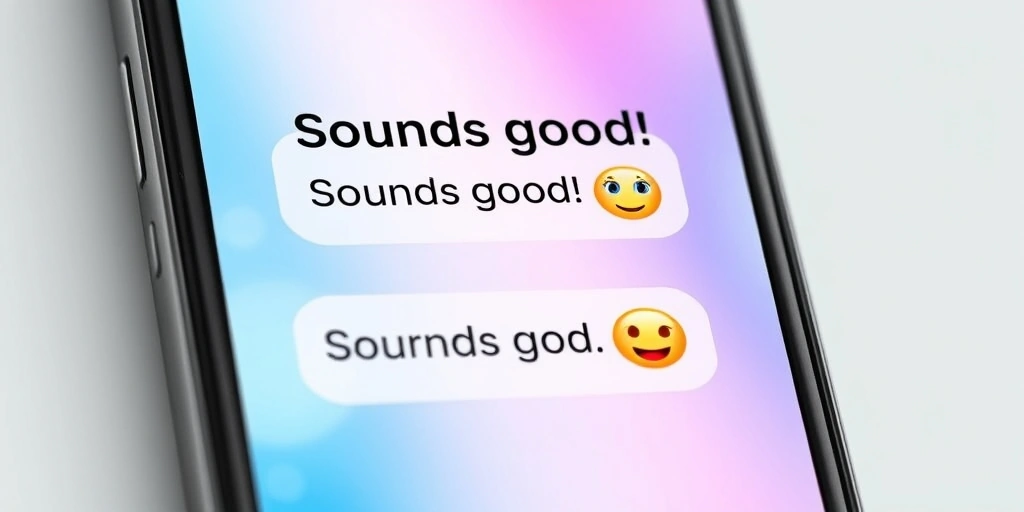
You know that feeling when you get a text that’s just a couple of words, followed by a string of emojis? Maybe it’s a simple “Sounds good!” or a “See you later.” On the surface, it’s straightforward. But then your eyes scan those little icons, and the whole tone of the message shifts. It’s warm, it’s sarcastic, it’s excited, or it’s hesitant—all without a single extra word. This magic isn't just in choosing the right emoji; it’s in the order you line them up.
Think about a classic pair: the crying laughing face and the red heart. We all use them. But have you ever noticed how the feeling changes depending on which comes first?
A message ending with 😂❤️ feels like a burst of joyful, affectionate laughter. “That story was hilarious, I love it!” The laughter leads, capped with love. It’s effusive and warm.
Now flip it: ❤️😂. Suddenly, it reads differently. It feels more like “Love you… you’re so silly.” Or even a gentle, loving tease. The heart establishes a foundation of care, and the laughter softens it, makes it playful. The core elements are identical, but the sequence whispers a different subtext.
Building a Narrative, One Icon at a Time
This isn't about grammar rules. It’s about narrative flow. When we read left to right, our brains process information in that order. The first emoji sets the stage. It’s the primary emotion or context. Each subsequent emoji modifies, reacts to, or builds upon that initial feeling.
Take a weekend plan text: “Drinks tonight?”
The reply: “Sure! 🍻😊” feels openly positive and agreeable. The beer suggests the activity, the smile confirms happy participation.
But what about: “Sure! 😊🍻”? Here, the smile comes first. It feels polite, maybe a bit more reserved or formally agreeable, with the beer glass adding the specific plan. The slight hesitation isn't in the words; it’s in the sequence.
This becomes even more powerful in shorter, more ambiguous replies. A simple “Okay.” is a blank slate. “Okay. 👍” is a solid affirmation. “Okay. 😔👍” is a resigned, reluctant agreement. The sad face establishes the true feeling, the thumbs-up performs the necessary social action of agreeing. The sequence tells the whole, real story the single word couldn’t.
The Subtle Art of the Three-Emoji Arc
With three emojis, you can craft a tiny emotional arc. Consider someone sharing minor bad news, like spilling coffee.
A reply of 😮😅🙏 tells a quick story: Shock/Sympathy (“Oh no!”) -> Shared awkward laughter (“It happens!”) -> A plea or supportive gesture (“Hope it’s okay!”).
Flip it to 🙏😅😮. The plea comes first (“Please don’t be mad”), then the nervous laughter, then the shock. It feels more apologetic and anticipatory of the other person’s reaction. The components are a toolkit, and the order is how you assemble them. For more on how pairs work, our piece on the hidden grammar of emoji pairs dives deeper into this two-icon dynamic.
Nuance in the Fast Lane
This is why sequences are so vital for short replies. We’re often typing on the go, in a hurry, or in the middle of something. We don’t have time for paragraphs explaining our exact mood. But we have a deep, instinctual need to convey tone—to be understood fully, not just factually. Emoji sequences are our shorthand for emotional complexity.
That “On my way! 🚗💨😬” is infinitely more informative than just “On my way!” It says: I’m moving, I’m speeding up, and I’m stressed/nervous about being late. The car, the dash, the grimace—they create a mini-movie.
Or the classic goodnight text: “Night! 🌙💤😴” The moon sets the scene, the sleeping symbol (zzz) indicates the action, and the sleeping face conveys the cozy, already-drifting-off feeling. “Night! 😴💤🌙” feels slightly different, like the person is already half-asleep, thinking of the action first, then the scene.
This layered meaning is a fascinating part of modern digital body language. It’s something we do intuitively, but when you start to notice it, you see it everywhere. It’s how we soften blows, amplify joy, or signal sarcasm without a clumsy “/s”. Exploring different emoji combinations can open up a whole new layer of expression.
When Order is Everything
Some sequences are so established they’ve become their own phrases. The “prayer hands” followed by the “crying laughing” face (🙏😂) is almost a single unit meaning “Thank you, that’s hilarious/I’m dead.” Reversing it (😂🙏) would be bizarre; it would read as laughter, then a sudden, serious plea.
This isn't a rigid code, but a living, evolving language. The meaning lives in the shared understanding between you and the person you’re texting. You learn their sequences, and they learn yours. That “👍🔥” from your friend might mean “cool, awesome,” while from another, “🔥👍” might carry more intense, hype energy.
The key is to think of your emojis not as a random handful of stickers tossed at the end of a sentence, but as a deliberate line of expression. That moment of choosing whether to put the star or the fire emoji first, the heart or the laughing face, is a moment of emotional editing. It’s you fine-tuning your message’s frequency so the person on the other end feels exactly what you mean, not just what you said. It’s a quiet, powerful way we add depth to our digital whispers. And as we explored in the secret language of emoji pairs, this dance between two icons is where a lot of this nuance begins.
📒 Related Blogs
More...Rhythm and Reaction: How Emojis Steer Fast-Paced Conversations
Beyond Words: How Emojis Transform Casual Chats into Playful Adventures!
The Silent Language: How Emojis Keep Our Everyday Conversations Flowing Smoothly
Beyond Words: The Subtle Power of Emojis in Navigating Sensitive Conversations
The Hidden Power of Emojis: How Tiny Icons Shape Our Digital Conversations
Emoji Magic: How Tiny Icons Make Your Fast Messages Truly Intentional