The Unspoken Power of Emojis in Your Work Messages

Mar 10,2026
You type out a quick message to a colleague: "Can you send me that report by EOD?" It's a simple, direct request. But before you hit send, your finger hovers. Something feels… off. It's perfectly polite, yet it reads as cold, maybe even demanding. So, you add a single character at the end. A smiling face. A thumbs-up. Suddenly, the entire feeling of the message shifts.
This tiny, almost subconscious act is something we do dozens of times a day. We are constantly, intuitively, using emojis to manage the conversational tone of our professional messages. Without them, our digital workplace would be a much more ambiguous and emotionally sterile place.
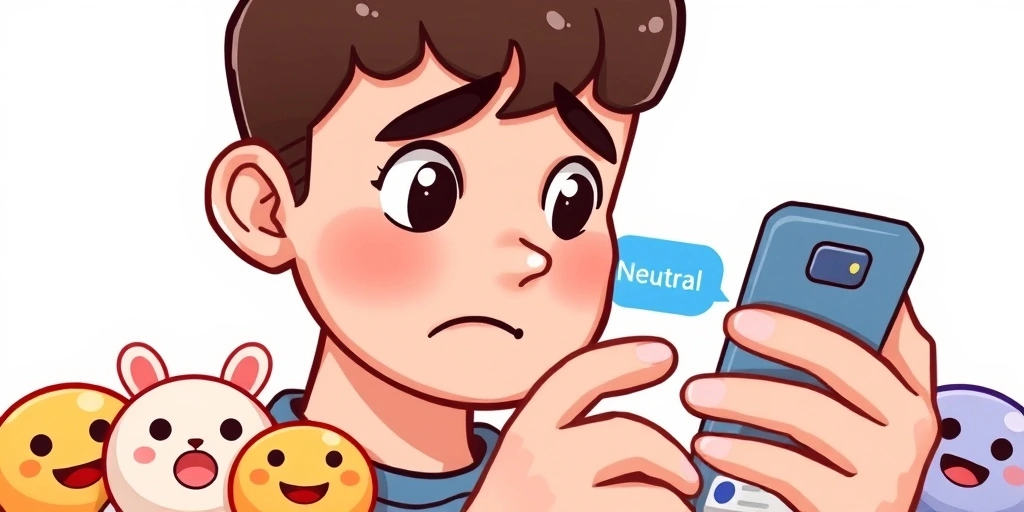
Think about how you read a message without any visual or tonal cues. The text is bare. Your brain has to work to interpret intent. Was that deadline reminder a gentle nudge or a sharp critique? Was the question "Any updates?" curious or impatient? In the absence of voice inflection and body language, we default to a neutral—or often negative—interpretation. Psychologists call this the negativity bias in text-based communication.
This is where the emoji steps in as a digital tone of voice. It's a micro-expression that carries a disproportionate weight. A simple smiley face :) or 😊 attached to a request doesn't change the words, but it fundamentally changes how they are received. It signals friendliness, collaboration, and a lack of hostility. It says, "We're on the same team."
From Transactional to Relational
Professional communication often walks a tightrope between being efficient and being human. We want to be clear and get things done (transactional), but we also need to maintain positive working relationships (relational). Emojis are a secret weapon for bridging that gap with incredible efficiency.
Consider feedback. "Great job on the presentation" is nice. "Great job on the presentation! 👏" feels celebratory and genuinely appreciative. The clapping hands emoji acts as a virtual round of applause. Similarly, "Let's revisit this tomorrow" can feel like a dismissal. "Let's revisit this tomorrow 🤔" suggests open-minded thinking and collaboration.
This subtle shift is powerful. It transforms dry, transactional exchanges into moments of human connection. In remote or hybrid work environments, where watercooler chats are rare, these small emotional punctuations become vital for building and maintaining team cohesion and trust. They are the digital equivalent of a warm tone of voice or a reassuring nod in a meeting.
The Risks of Misinterpretation
Of course, with great power comes great responsibility. The same ambiguity that emojis solve can also be created by them if used carelessly. The line between friendly and unprofessional, or between sincere and sarcastic, can be thin.
The classic example is the dreaded grimacing face 😬. One person might use it to express sympathetic awkwardness: "Sorry for the late notice on this request 😬". Another might read it as insincerity or even mockery. The crying-laughing emoji 😂 is another minefield in professional settings. What's hilarious to a close teammate might seem immature or dismissive to a client or senior leader.
This is why context and relationship are everything. The emoji etiquette you use with your immediate team on a Slack channel will be different from what you use in a formal email to a new client or in a company-wide announcement. It's less about hard rules and more about social awareness—reading the room, even when the room is digital. For more on the nuanced rules that develop over time, you might find this exploration of long-term conversation dynamics interesting.
Emojis as Emotional Shortcuts
At their core, emojis in professional messaging are emotional shortcuts. They are a way to efficiently convey nuance that would otherwise take a full sentence to explain.
"Thanks!" versus "Thanks! 🙏" The latter adds a layer of genuine gratitude and humility. "I see your point" versus "I see your point 🤔" The latter shows you are actively considering it. "This is due Friday" versus "This is due Friday ⏳" The hourglass adds a visual, slightly softer sense of urgency.
These shortcuts prevent misunderstandings and preemptively smooth over potential friction. They make our communication not just faster, but richer and more aligned with our true intent. They help us be perceived as we want to be seen: competent, but also collaborative, friendly, and human.
The influence of emojis on conversational tone isn't a trivial side effect of digital culture; it's a fundamental adaptation. As our primary workspace has moved onto screens, we have collectively adopted a new lexicon to compensate for what's lost in translation. We are learning to write with emotion built into the punctuation. To explore more about how emojis shape our digital dialogues, check out other posts in our Emoji & Communication category.
So, the next time you pause before sending that email or Slack message, pay attention to that instinct to add an emoji. It's not frivolous. It's you, expertly calibrating the emotional temperature of your words, ensuring your professional tone lands exactly as you mean it to.
📒 Related Blogs
More...The Unseen Power of Emojis: How They Steer Our Subconscious in Every Text
The Secret Shortcut: How Emojis Hack Your Brain in Everyday Texts
Beyond Words: How Emojis are Revolutionizing Global Communication
Emoji Magic: How a Tiny Icon Changes Everything in Your Group Chats
When Your Friendly Emoji Sparks a Public Meltdown
The Secret Language of Two: How Emoji Pairs Reshape Group Chat Understanding