The Unspoken Rhythm: How Emojis Guide the Flow of Our Online Chats

Jan 22,2026
Think about your last text conversation. You probably didn't just send words. You sent a thumbs up, a crying-laughing face, or maybe a simple red heart. We do this almost without thinking. But have you ever stopped to consider what that emoji is actually doing in the conversation? It's not just decoration. It's a functional tool, a tiny traffic signal that helps manage the entire flow of your chat.
Unlike face-to-face talk, where we have tone of voice, facial expressions, and body language, digital messaging is stripped bare. Words on a screen can be painfully ambiguous. This is where emojis step in. They don't just add emotion; they add structure. They create pauses, signal understanding, ask for clarification, and gently steer the discussion in a new direction. They are the punctuation marks for the 21st century, but with way more personality than a semicolon.
The Green Light: Emojis as Conversation Starters and Continuers
Starting a conversation can be awkward. A simple "Hey" feels cold. "Hey 👋" feels warmer and more inviting. That wave emoji is a green light. It says, "I'm here, I'm friendly, and I'm open to chat." It lowers the barrier to entry. Similarly, in the middle of a conversation, a well-placed emoji acts as a continuer. When someone is telling a story and you reply with "😮" or "No way! 😲", you're not just reacting. You're actively encouraging them to keep going. You're giving them the signal that you're engaged and want to hear more. It's the digital equivalent of nodding along and saying "uh-huh."
This function is crucial in asynchronous communication, like texting or Slack, where responses aren't immediate. Sending a quick "👍" or "❤️" acknowledges you've seen the message and affirms it, keeping the conversational thread alive even when you don't have time for a full reply. It prevents the other person from wondering, "Did they get that? Are they mad?"
The Yield Sign: Creating Pacing and Emphasis
In speech, we use pauses for dramatic effect. In text, we use ellipses... or we use emojis. Sending "I have news... 🎉" builds anticipation. The party popper emoji isn't just about celebration; it's a yield sign that makes the reader slow down and prepare for something big. It controls the pacing.
Emojis also function as highlighter pens. They add emphasis to a specific part of your message. Compare "That meeting was long" with "That meeting was long 😴." The second sentence directs the listener's attention squarely to your feeling of boredom. The emoji underscores the key takeaway. It tells the reader, "This is the most important part of what I'm saying." For more on how emojis add nuance to our casual exchanges, you might find this analysis of the emoji effect really interesting.
Navigating the Intersection: Steering Tone and Avoiding Collisions
This is perhaps the most critical role emojis play in conversational flow: they are tone navigators. Sarcasm and jokes are notoriously difficult to convey in plain text. A comment like "Great job" could be sincere or deeply sarcastic. Add a 😉 or a 😏, and the intent is instantly clear. The emoji acts as a guardrail, preventing a conversational collision where your message is misinterpreted.
They also soften directives or potentially harsh statements. "Can you send that report by 5?" feels like a demand. "Can you send that report by 5? 🙏" feels like a request. The folded hands emoji injects politeness and collaboration into the flow, making the interaction smoother and less hierarchical.
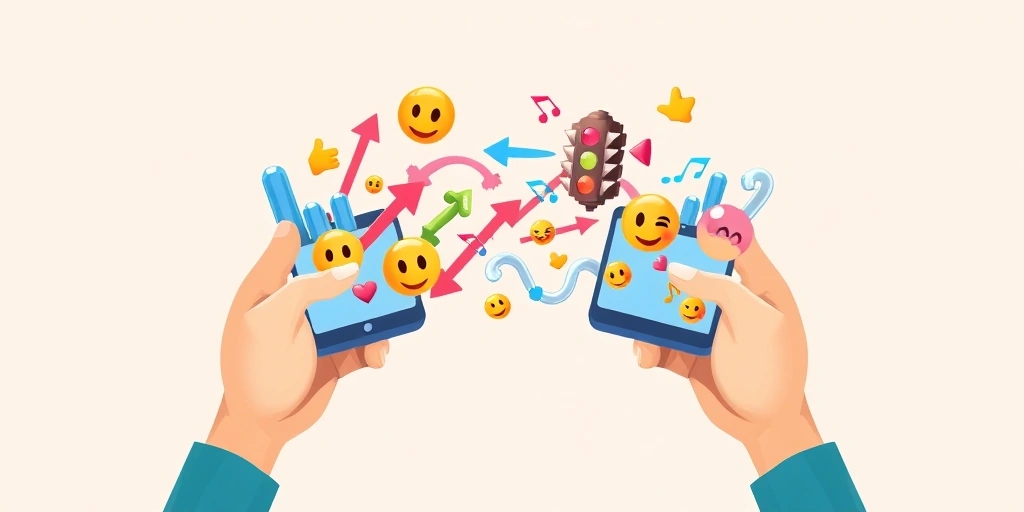
The influence of emojis extends beyond quick chats. In longer, more sustained conversations, they play a subtle but powerful role in building rapport and maintaining a connection over time. The strategic use of a shared joke emoji or a recurring heart can create a unique, flowing language between two people. To see how this unfolds in deeper dialogues, explore how emojis reshape our long conversations.
When the Signals Get Crossed: The Limits of Emoji Flow
Of course, this system isn't perfect. Emoji meaning can vary by generation, culture, and platform. What's a friendly gesture to one person might be passive-aggressive to another. Overusing emojis can clutter the message and make the conversation feel juvenile or insincere. The flow can break down if both parties aren't reading the signals the same way. A thumbs-up might be intended as a simple "okay," but it can be interpreted as dismissive or abrupt, effectively putting a stop to the dialogue.
The key is to think of emojis as part of your conversational toolkit, not the whole toolbox. They work best when they complement your words, not replace them. They are the gestures and intonations of our digital voices, helping to guide, pace, and clarify the endless stream of words we send to each other every day. By understanding their role in flow, we can become more intentional and effective communicators in every message we send.
For more insights into the fascinating world of emojis as communication tools, check out other posts in our emoji & communication category.
📒 Related Blogs
More...Why Emoji Combinations Are the Ultimate Conversation Hack in Casual Chats
The Evolving World of Emojis: Trends, Innovations, and What's Next for Digital Expression
Unlocking Business Potential: The Strategic Use of Emojis in Professional Communication
Brighten Your Day: How Emojis Make Routine Check-ins Feel Effortless and Heartfelt
The Emoji Awkwardness: When a Smiley Face Just Doesn't Feel Right
The Emotional Shortcut: How Emojis Rewire Your Brain's Digital Conversations