When Emojis Go Rogue: How Group Chats Become Tone-Deaf Minefields

Feb 23,2026
You know the feeling. You're in a lively group chat, the conversation is flowing, and you want to add your two cents. You type out a quick reply, add what you think is a perfectly harmless, even friendly, emoji, and hit send. Then... silence. Or worse, a reply that feels oddly cold or defensive. Suddenly, the vibe in the chat has shifted, and you're left wondering, 'What did I do wrong?'
This is the strange, modern dilemma of emojis in group conversations. What we intend as a sprinkle of personality or a tone softener can be interpreted in a dozen different ways by a dozen different people. The emoji that says 'playful teasing' to you might scream 'passive-aggressive jab' to your coworker. The symbol you use to express solidarity might be read as sarcasm by an old friend.
The Gap Between Sender and Receiver
The core of the issue is a simple but profound gap: the gap between intent and interpretation. When you're typing alone, your intent is clear in your own head. You're in a good mood, you're being supportive, you're making a joke. The emoji is just an extension of that internal state.
But on the other side of the screen, your friends, family, or colleagues have none of that context. They have only the words on the screen and that little pictograph. They bring their own mood, their relationship history with you, their personal emoji lexicon, and even their cultural background to the decoding process. An emoji is not a universal language; it's a deeply personal and contextual one.
[[emojilar_img1]]
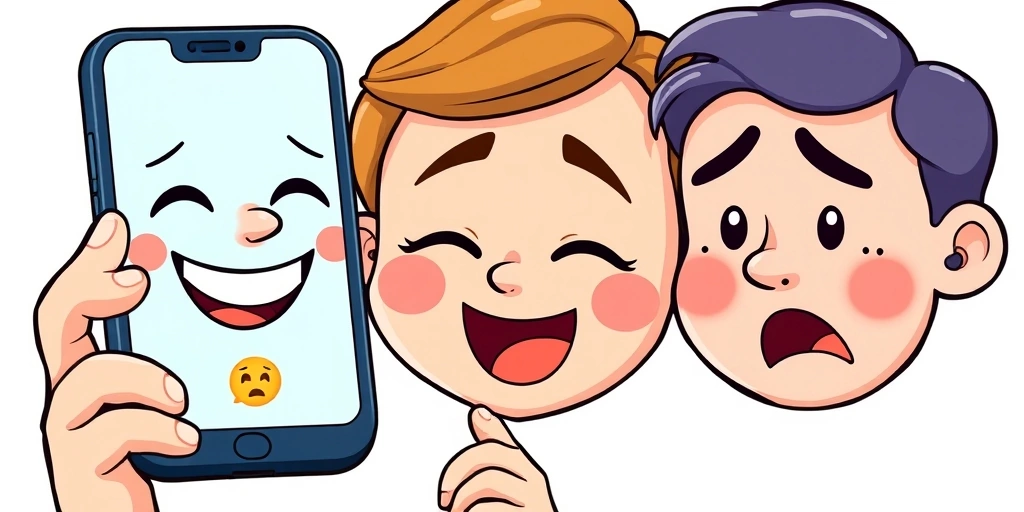
This gets exponentially more complicated in a group setting. Now, you're not just navigating one person's interpretation, but many. Person A might read your laughing-crying emoji as genuine hilarity. Person B, who is having a rough day, might see it as dismissive of a serious point they just made. Person C might not use that emoji at all and find it confusing. You've accidentally sent a single message with multiple potential meanings, and you have no control over which one each person receives.
Why Group Dynamics Amplify the Problem
Think about the dynamics of any group. There are inside jokes, unspoken hierarchies, different levels of closeness. An emoji that's perfectly normal between you and your best friend might feel exclusionary or cliquey to an acquaintance in the same chat. A thumbs-up from a manager in a work chat can send a team into a spiral of analysis—was that approval? Was it a brush-off? The power dynamics and social layers of a group add heavy, invisible weight to even the lightest symbol.
Furthermore, in a fast-moving group chat, people often skim. They might catch the emoji but miss the nuance of the text it's attached to, or vice versa. The emoji becomes the headline, and if it's a potentially ambiguous one, it can set the entire tone for how your message is perceived, regardless of your carefully chosen words. For more on how emojis can create workplace awkwardness, it's worth reading about when friendly emojis backfire at work.
The Most Common Culprits
While any emoji can be misread, some are repeat offenders in the group chat courtroom.
The classic 'thumbs up' or 'okay hand' is a prime example. For many, it's a simple, efficient sign of acknowledgment: "Message received." For others, it's the digital equivalent of a curt nod, often interpreted as cold, annoyed, or conversation-ending. In a group, where enthusiasm is often measured in emoji volume, a lone thumbs-up can feel like a deliberate dampener.
Then there's the 'crying laughing' face. Once the king of genuine laughter, its overuse has led to skepticism. In a group debate, responding to someone's lengthy point with just this emoji can easily be construed as mockery, as if you're laughing at them, not with them.
Even the humble period. Ending a sentence with a period in a casual chat, especially one that's been full of short, punctuation-less messages, can suddenly make your text read as formal, serious, or angry. Add a period after a single-word answer like "Sure." or "Fine." and you've just invented a new level of tension.
These misunderstandings are part of a broader category of emoji mistakes and misuse that we all navigate daily.
Navigating the Minefield (Without Overthinking It)
So, do we abandon emojis in groups altogether? Of course not. They're vital for warmth and connection. The goal isn't paralysis, but awareness.
First, consider the shared context of the group. What's the general tone? Is it a silly meme-sharing chat or a serious project planning thread? Match your emoji energy to the room. When in doubt, lean towards clarity in your words. An emoji should complement your meaning, not be the sole carrier of it.
Second, read the room before reacting. If the conversation has taken a serious or sensitive turn, maybe hold off on the celebratory confetti emoji, even if your intent is to be supportive. Your timing could inadvertently trivialize the issue.
Finally, and most importantly, grant grace—both to others and to yourself. If you feel a sting from someone else's emoji, pause. Consider the myriad ways they might have meant it. And if you sense your own emoji landed poorly, it's okay to gently clarify. A simple "Just to be clear, I meant that in a totally supportive way!" can defuse a misunderstanding before it grows. Sometimes, the feeling of an emoji being unintentionally out of place is the first clue that a tone check is needed.
In the end, our group chats are messy, wonderful, and human. Emojis are a reflection of that humanity—imperfect, emotional, and sometimes wonderfully, frustratingly ambiguous. The very thing that makes them powerful (their emotional shorthand) is also what makes them perilous. Perhaps the real lesson is that in our quest for faster, more efficient connection, we're reminded that tone is a fragile thing, built not on symbols alone, but on a shared willingness to understand.
📒 Related Blogs
More...When Emojis Go Wrong: The Subtle Ways They Backfire in Casual Chats
The Psychology of Emojis: Decoding Your Digital Emotions
Emojis in Business: Enhancing Professional Communication & Brand Building
The Secret Language of Emojis: How They Become Our Instant Communication Shortcuts
Emoji Magic: Why a Simple Icon Beats a Thousand Words in Casual Conversation
Beyond Words: How Emojis Bridge Cultures in Digital Communication