The Emoji Enigma: How Those Little Icons Accidentally Confuse Our Casual Chats

Dec 30,2025
Emojis have become the secret sauce of our digital conversations, adding that extra sprinkle of personality, emotion, or even a touch of irony to our texts and chats. They're quick, they're colorful, and they often feel like the perfect shorthand when words just don't quite cut it. Yet, for all their expressive power, there's a peculiar side to our beloved icons: they can sometimes throw a wrench into our communication, blurring our true intent in casual conversations.
It’s a scenario many of us have experienced. You send a message, confident in its meaning, only to receive a reply that suggests your words (or rather, your chosen emoji) were interpreted in a completely different light. Suddenly, a simple statement feels like a riddle, and a lighthearted comment takes on an unintended edge. It’s the digital equivalent of someone mishearing you in a noisy room, but instead of sound, it’s the nuance of a tiny graphic that gets lost.
The Nuance Trap: When a Smile Isn't Just a Smile
Consider the humble smiley face. On the surface, it’s universally positive, right? But depending on the context, or even the specific emoji variant, it can shift from genuine warmth to polite indifference, or even a hint of sarcasm. A 😊 feels different from a 🙂, and both are miles away from a 😂. What you intend as a friendly acknowledgment, your friend might read as a slightly dismissive "okay, whatever." The emotional depth we try to convey can get flattened or distorted by these small choices.
This isn't to say emojis are inherently problematic; far from it. They enrich our daily interactions. However, their very conciseness can be their undoing. In face-to-face chats, we have tone of voice, body language, and immediate feedback to clarify any ambiguity. In a text, an emoji is often the only non-verbal cue available, and it has to carry a heavy load.
The Silent Subtext of a Thumbs Up
Take the 👍 emoji. For many, it's a simple affirmation: "Got it," "Sounds good," "Yes." But for others, particularly in certain professional or semi-casual contexts, it can feel abrupt, dismissive, or even passive-aggressive. Imagine asking a detailed question and getting only a 👍 in return. Was your question thoroughly considered, or simply acknowledged with minimal effort? The sender likely meant no harm, but the receiver is left to fill in the blanks, often with their own anxieties or assumptions.
Sometimes, this blurring isn't about the emoji itself, but how it interacts with the words around it. A slightly critical comment followed by a 😉 might be intended as playful teasing, but it could easily land as genuinely critical with a side of smarminess. It's a delicate balance, and one that often leads to unexpected tone twists in our conversations.
Context is King, But Often Missing
One of the biggest culprits behind blurred intent is the lack of context in casual digital exchanges. We often text while multitasking, sending quick replies without fully considering the full arc of the conversation or the mood of the recipient. In these rapid-fire interactions, a single emoji is sometimes expected to convey a complex emotional state or subtle meaning that it simply wasn’t designed for.
Think about a conversation where you're discussing a minor inconvenience. If you type, "Ugh, my internet is out again," and follow it with a 😂, are you laughing it off, or are you genuinely frustrated but trying to make light of it? Without more words or real-time interaction, the interpretation is wide open. This ambiguity can lead to a string of clarifying messages, or worse, unspoken misunderstandings that simmer beneath the surface of our digital friendships.
Generational Gaps and Personal Dictionaries
Adding another layer of complexity is the fact that emoji meanings aren't always universal. What's a perfectly innocent 💀 (skull emoji) to a Gen Z user (meaning "I'm dead" from laughing) might be a grim and foreboding symbol to someone from an older generation. Each individual, and indeed each social group, develops its own subtle "emoji dictionary," and when these dictionaries don't align, intent can go astray quickly. This is particularly true in lighthearted exchanges where humor or irony relies heavily on shared understanding.
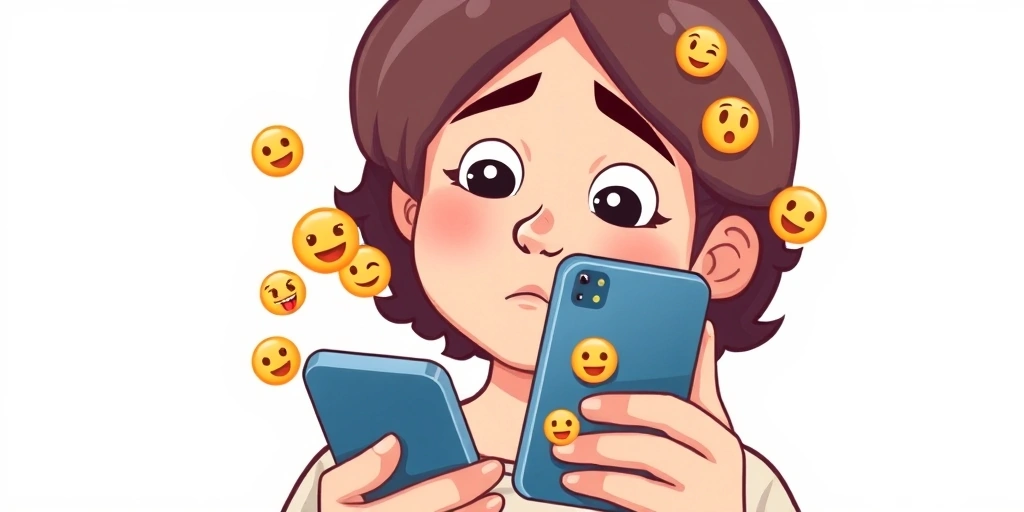
When "Okay" Becomes a Question Mark
It's not just the complex or newer emojis that create confusion. Even the most straightforward ones can cause a pause. Sending "Okay" versus "Okay 👍" versus just "👍" carries different weights. The single thumbs-up might feel curt to some, while the full word "Okay" followed by a thumbs-up feels more reassuring. Conversely, a lone "K" can feel dismissive, while "K." might feel formal. These subtle variations, often unconsidered by the sender, become significant interpretation points for the receiver. The simpler the message, the more weight each tiny symbol can carry.
The solution isn't to abandon emojis entirely. They are too woven into the fabric of modern communication. Instead, perhaps it’s about a mindful approach. If something is important, sensitive, or open to misinterpretation, a few extra words can go a long way. Sometimes, clarity trumps conciseness, especially when we want to ensure our good intentions are truly understood.
The Unspoken Power of a Winky Face
Consider the 😉 (winky face). It’s often used to signal playfulness, sarcasm, or a shared secret. But in a casual chat, especially with someone you don't know extremely well, it can sometimes be misconstrued. What you intend as a lighthearted joke could be interpreted as flirting, or even condescension. Conversely, its absence might make a sarcastic comment sound genuinely harsh. These are the small, everyday communication challenges where emojis lead to big misunderstandings, highlighting the need for careful consideration.
Ultimately, our digital conversations are a delicate dance. Emojis, while brilliant tools for expression, require us to be more attuned to how our messages might land. It's not about perfect emoji etiquette, but about recognizing the potential for ambiguity and being ready to clarify if needed. Because in the end, connection is what truly matters, and sometimes, that means a little extra thought about those colorful little icons that punctuate our daily digital lives.
Embracing the inherent imperfections of digital communication, and understanding that intent can often be blurred, helps us navigate these waters with more patience and grace. It's a continuous learning curve, one text at a time, reminding us that even the simplest emoji can carry a world of unspoken meaning, waiting to be deciphered.
📒 Related Blogs
More...Unlocking Emotions: How Emojis Completely Transform How Your Messages Are Received Online
How Emojis Evolve: The Secret Language of Modern Internet Culture
Beyond Words: How Emojis Bring Clarity and Connection to Project Updates
The Unspoken Language: How Emojis Cut Through Text in Familiar Chats
The Speed of a Smile: How Emojis Shape Intent in Fast-Paced Chats
The Secret Weapon for Stressful Workdays: How Emojis Soften Project Updates