The Quick Emoji That Makes Your Busy-Day Replies Feel Kind

Mar 18,2026
It’s 3 PM. Your screen is a mosaic of deadlines. A Slack message pings: “Hey, just checking in on the Q3 report status.”
You have exactly 4.2 seconds to reply before diving back into the spreadsheet abyss. The honest answer is a frantic, internal “I’m buried, but it’s fine, I’ll get it done.” Typing all that out isn’t an option. So you go for the classic, efficient: “On it.”
You hit send. And immediately, a tiny wave of guilt washes over you. Did that sound terse? Rude? Like you’re brushing them off?
We’ve all been there. In the high-speed chase of a workday, our messages get shorter. But brevity often comes at the cost of tone. Without the context of a smile or the cadence of a voice, our efficient words can land with a unintended chill.
This is where the humble emoji performs its daily magic.
The Tone Gap in Fast-Paced Work
Think about the difference between “On it.” and “On it! 👍”
The words are identical. The workload is the same. But the feeling received by your colleague is worlds apart. The first is a bare fact, a data point. The second is a data point wrapped in a quick, reassuring nod. It acknowledges the request, confirms action, and adds a sliver of positive intent—all in one extra character.
When we’re busy, we’re often communicating from a place of scarcity: scarce time, scarce attention. Emojis are a tool of abundance. They let you donate a little emotional bandwidth you don’t actually have to spare. They bridge the gap between what you can type and how you want the other person to feel.
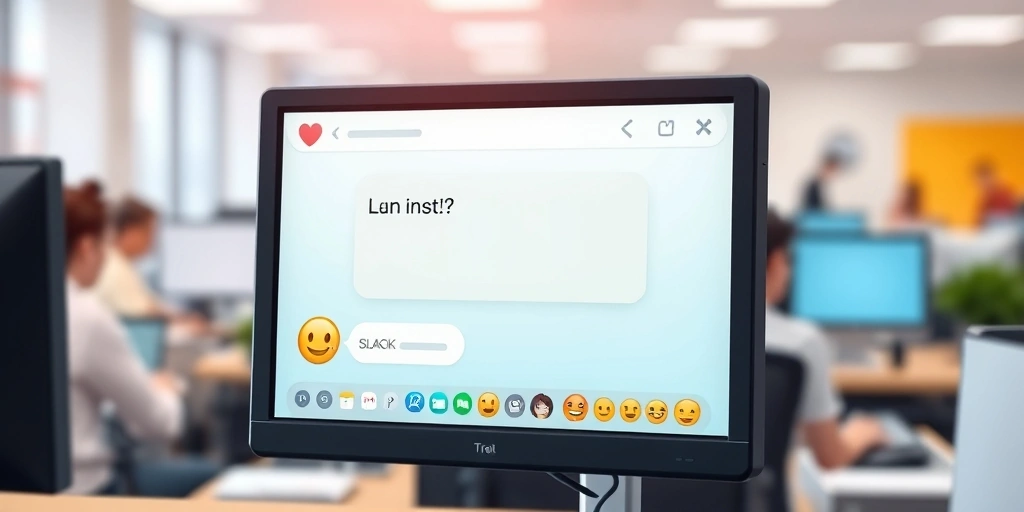
It’s not about being unprofessional or frivolous. It’s about precision. In a text-based world, an emoji is a precision instrument for conveying nuance. A “Got it. 😊” in a status thread doesn’t just mean received; it means “received, and I’m on board, and no worries.” It preemptively soothes potential friction.
Beyond the Thumbs-Up: Building a Micro-Vocabulary
While the 👍 is the undisputed workhorse, a small repertoire can handle most quick-check-in scenarios.
“Will do! ✍️” adds a layer of “I’m already taking notes.” “Looking into it now. 🔍” visually represents the action of searching. A simple “Thanks! 🙏” in response to a forwarded file carries more weight than the words alone. Even the humble “…” can be softened with a thinking face “…🤔” to show active processing instead of hesitation.
The goal isn’t to write hieroglyphics. It’s to choose one symbol that acts as a tone-of-voice amplifier for your clipped phrase. For more on building this subtle vocabulary for team syncs, this piece explores some specific lifesavers.
Why This Small Act Feels So Considerate
On the receiving end, that tiny emoji does a lot of heavy lifting. In the absence of non-verbal cues, our brains are primed to fill in the blanks, often negatively (a phenomenon sometimes called “negative attribution bias” in remote communication). A plain “OK” can be read as passive-aggressive. An “OK 👌” is almost always read as neutral or positive.
By adding an emoji, you’re doing the interpretive work for your colleague. You’re guiding them to the correct emotional context. You’re saying, “I know this reply is fast, but don’t read stress or annoyance into it. We’re good.”
It’s a micro-act of empathy. It says, “I see you, I hear your request, and I value our working relationship enough to ensure my haste isn’t misinterpreted.” In the long run, these micro-acts are the glue that maintains trust and warmth on a team, especially a distributed one. They prevent the slow erosion of goodwill that can happen when communication feels consistently transactional and cold.
So the next time you’re deep in flow and need to fire off a two-word reply, pause for a half-second. Consider the gap between your intent and how your words might land. Then, gift a single character. That 😅, that 🚀, that 🙌—it’s more than a picture. It’s the quickest, kindest way to say, “I’m here, I’m human, and we’re in this together,” even when you’re racing against the clock.
For more thoughts on integrating these small signals into your professional rhythm, explore our other content on emoji use at work.
📒 Related Blogs
More...The Quiet Comfort of Emojis: How a Simple Icon Says 'I'm Here'
The Unspoken Power of Emoji Order: How Sequence Changes Everything
The Tiny Gesture That Makes Work Chats Feel Human
The Hidden Power of Emojis: How a Simple 😊 Shapes How Others See You Online
The Psychology Behind Emojis: Why We Love to Tap and Send Them
The Psychology Behind Emojis: Unlocking Our Digital Emotions