The Quiet Language of Care: How Emojis Help Us Navigate Sensitive Conversations

Jan 31,2026
We've all been there. The cursor blinks in the text box, a silent metronome counting the seconds of our hesitation. The words we type feel too heavy, too direct, or somehow not enough. We delete them. We start again. And then, often, our thumb finds its way to the emoji keyboard. It’s not a replacement for the words, but a companion to them—a soft landing pad for a hard thought.
In the quiet, ongoing message threads of our lives—with a close friend, a family member, a partner—some of the most sensitive topics find their way to the surface. A health scare. A strained relationship at work. The slow, dull ache of anxiety on a Tuesday afternoon. We might not be ready to dissect it in a long phone call. We might not have the emotional vocabulary for it at that exact moment. But we need to put a flag in the ground. We need to say, "I am here, in this feeling, and I am sharing it with you."
That’s where the quiet language of emojis comes in.
Think about the simple, pleading face. It rarely means "please pass the salt." In the context of a vulnerable confession, it can translate to: "I'm sharing something difficult and I'm scared of your judgment." Or the heart. It’s not just love; in the middle of a story about grief, it can mean, "My heart is with you, and I have no other words that fit." These symbols become emotional shorthand, allowing us to point to a complex feeling without having to build the entire scaffolding of language around it. They make the unstated, stated.
This is especially powerful because text strips away so much. There’s no tone of voice, no hesitant pause, no softening glance. A sentence like "I’m really struggling" can read as a factual statement, a cry for help, or a wall of despair. But tag a weary face or a crumpled paper emoji onto the end, and the emotional landscape instantly becomes clearer. It’s a way of saying, "Read this in a tired, vulnerable voice." It guides the recipient into the correct emotional register, preventing the kind of digital misunderstandings that can make hard conversations even harder. For more on how emojis prevent these misunderstandings, you can read about how they act as silent peacemakers.
The Space Between the Words
What I find most beautiful about this use of emojis is that they create space. They don't force a resolution or demand an immediate, perfectly articulated response. A single emoji as a reply—a hugging face, a tear, a nodding head—can be profoundly affirming. It says, "I see your feeling. I am sitting in this space with you. We don't have to fix it right now." It’s a digital form of sitting in comfortable silence with someone who is hurting.
This is a far cry from the notion that emojis are frivolous or a degradation of language. In these contexts, they are a sophisticated tool of emotional precision. They allow for nuance where plain text fails. The difference between a smiling face with a tear and a loudly crying face is the difference between bittersweet acceptance and overwhelming sorrow. We instinctively know this gradient of feeling, and we use it to calibrate our shared experience.
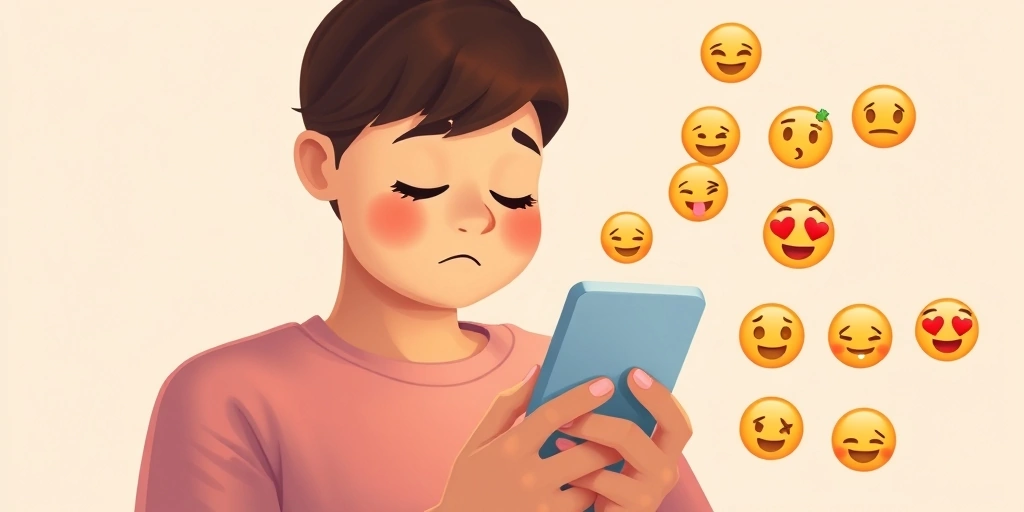
These quiet threads are our digital safe houses. They are the back channels where we process the world before we have to present a polished version of ourselves elsewhere. The emoji becomes a key to that safe house—a quick, recognizable signal that says, "What follows is real, and it's for you." It lowers the barrier to vulnerability. Sending a string of heartbreak emojis can feel easier than typing "I think my heart is breaking," yet it communicates the same core truth, often with more layered resonance.
When Words Are Too Much, or Not Enough
There are also those moments when an emoji says everything because words would say too much. A friend texts about a frustrating interaction with a difficult person. Replying with the exploding head or the face screaming in fear isn't just saying "That's crazy." It's an act of alliance. It's saying, "I am mirroring your outrage back to you so you know it's valid. I am on your team." The emotional labor of crafting a paragraph of validation is condensed into a single, powerful glyph of shared feeling.
Conversely, emojis can say what words cannot when comfort is the only goal. After a loss, what can you possibly say? Often, the most honest response is not a platitude, but a single candle or a white flower. It acknowledges the gravity and the sanctity of the moment without trampling on it with inadequate language. It’s a quiet, digital moment of silence. This unspoken peace is a powerful force, as explored in this piece on calming digital ripples.
So the next time you find yourself hovering over the send button, grappling with how to broach something tender or heavy, don't dismiss the impulse to reach for an emoji. It’s not a cop-out. It’s part of a new, deeply human lexicon we're building for connection in a digital age. It’s how we whisper in a medium that defaults to a shout, how we add a gentle pressure of the hand to a sentence, how we bridge the gap between what we feel and what we can bear to spell out. In the quiet threads that matter most, these small symbols do the very big work of helping us hold space for each other, one heartfelt pixel at a time.
They remind us that even in our most hesitant, vulnerable moments, we are still trying to connect. And sometimes, a little picture of a heart, a tear, or a softly smiling face is the most truthful translation of all.
📒 Related Blogs
More...Emojis in Pop Culture: How They Influence Movies, Fashion & Beyond
Lost in Translation? The Surprising Ways Emojis Stir Up Mixed Reactions Online
How Emojis Save the Day: Bringing Clarity and Warmth to Your Work Emails
How Emojis Tell the Story of Our Changing Digital World
When Your Emoji Tone Goes Rogue: The Unseen Pitfalls of Texting