The Unspoken Language: How Emojis Became Our Go-To Quick Reply

Jan 26,2026
Think about the last time you were in a casual chat with a friend or family member. Maybe you were sharing a funny story, making plans, or just checking in. In those relaxed, familiar spaces, our communication often shifts. We don't always need—or want—to type out a full, formal response. That's where the magic of the quick reply comes in, and more often than not, that quick reply is an emoji.
It's not about being lazy. It's about efficiency and emotional resonance. When someone sends you a photo of their delicious-looking lunch, a string of heart-eyes or a drooling face does the job perfectly. It acknowledges their message, shares your reaction, and keeps the conversation flowing, all in a single tap. The emoji stands in for a whole sentence like "That looks incredible, I'm so jealous!" but feels more immediate and, somehow, more genuine.
This is a big part of how emojis fit into our daily life. They smooth out the rough edges of digital text, which can so easily be misread. A plain "okay" can feel cold or dismissive. An "okay" followed by a thumbs-up or a smiling face carries a completely different, warmer tone. The emoji does the heavy lifting of conveying your intent.
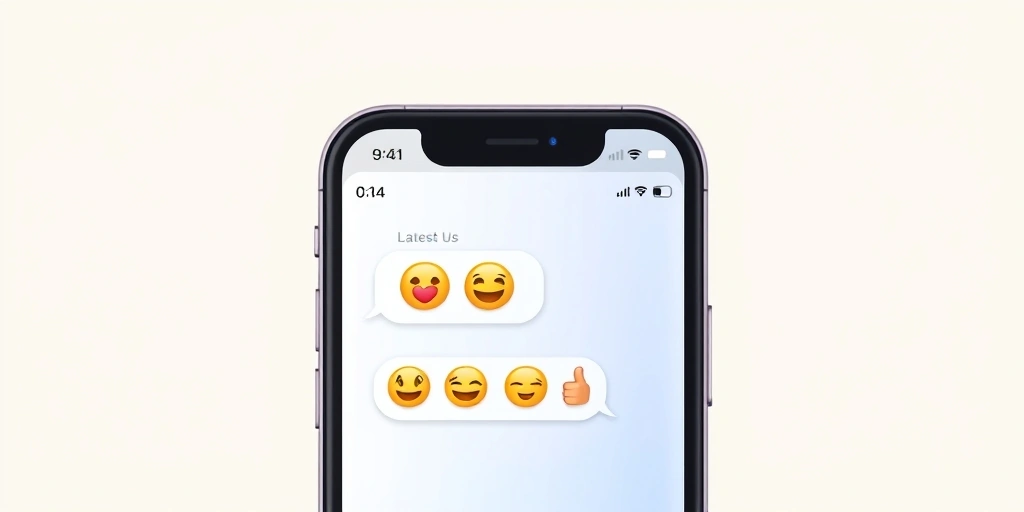
These quick-reply emojis function as little social lubricants. They're the digital equivalent of a nod, a smile, or a laugh across the table. In a group chat where everyone is talking over each other with messages, reacting with a laughing-crying face or a shocked emoji is a way to participate without adding to the noise. It says, "I saw that, and it was hilarious," or "I can't believe you just said that!" It keeps you in the loop and connected.
There's a quiet comfort in this exchange. You don't have to overthink it. The pressure to craft a witty or insightful response evaporates. The conversation becomes less about performance and more about simple, shared presence. As discussed in another look at emojis in everyday chats, this low-stakes communication is vital for maintaining casual bonds.
Beyond the Thumbs Up
While the thumbs-up and heart are the classic quick replies, our vocabulary has expanded. The folded hands emoji can be a quick "thank you" or "please." The fire emoji is instant praise. The eyes emoji signals interest or "I'm watching this closely." We've developed a shared understanding of what these symbols mean in context, which makes them even more powerful as shorthand.
This isn't to say words don't matter. Of course they do. But in the specific context of a familiar, casual chat, emojis and words work in tandem. Sometimes the emoji is the entire reply. Sometimes it punctuates a short sentence. The blend is what feels natural. It mirrors how we talk in person—with words, facial expressions, and gestures all mixed together.
When a Picture is Worth a Few Words
The beauty of using an emoji as a quick reply is its ambiguity in the best possible way. It's open to interpretation within a shared understanding. A single smiling face with smiling eyes can mean "I agree," "That's nice," "Good to hear from you," or "I'm listening," depending on the conversation that came before it. The recipient, knowing you and the context, understands which meaning you intend. This is the emoji magic at work—conveying complex social cues with simplicity.
So next time you're in the middle of a busy day and a friend's message pops up, don't feel bad if your instinct is to reply with just an emoji. You're not being short. You're participating in a modern, efficient, and surprisingly nuanced form of connection. You're using the unspoken language of familiar chats to say, "I'm here, I get it, and I'm with you." And often, that's more than enough.
It just becomes part of the rhythm. The conversation ebbs and flows, with words and icons dancing together, making the digital space feel a little more human, one quick reply at a time.
📒 Related Blogs
More...The Art of Emoji Etiquette: Mastering Professional Communication with Emojis
The Ever-Shifting Emoji Code: How Online Trends Reshape Digital Language
Decode Emojis: Uncover Hidden Meanings & Secret Emoji Language
Unlocking Emotions: How Emojis Completely Transform How Your Messages Are Received Online
The Global Language of Emojis: Decoding Cultural Meanings and Interpretations
Beyond Words: How Emojis Enhance Emotional Expression in Digital Communication