The Unspoken Magic of Emojis: How a Tiny Icon Can Save an Awkward Conversation

Mar 23,2026
You know that feeling. You send a text. Maybe it's a bit of a joke, or a piece of news, or just a simple question. You wait. The three dots appear, then vanish. Silence. Your brain, being the wonderful overthinking machine it is, immediately starts running scenarios. Were they offended? Did they not get it? Are they just busy? That little pocket of digital silence can feel incredibly loud.
It's in these exact moments, more often than we even consciously register, that emojis do their quiet, magical work. They swoop in like a digital superhero, not with a cape, but with a smiling face, a crying-laughing emoji, or a simple heart. They soften the edges of our typed words and fill the void left by the absence of tone, facial expression, and body language.
When Words Are Just Black and White
Think about how you talk in person. A raised eyebrow, a slight smile, a shrug of the shoulders—these non-verbal cues do at least half the work of communication. They tell the other person how to interpret your words. In a text, all of that is stripped away. What's left is a stark, neutral sentence that our brains are desperate to color in with meaning, and often, we color it with anxiety.
That's where the humble emoji becomes a lifeline. Adding a 😊 to a "Sure, that's fine" transforms it from potential passive-aggression to genuine agreement. A 😬 after a slightly risky joke says, "I'm cringing a little too, but let's laugh about it." It's a tiny, efficient packet of emotional context. It tells the reader, "This is the tone. This is the spirit in which I mean this." Without it, we're all just guessing in the dark.
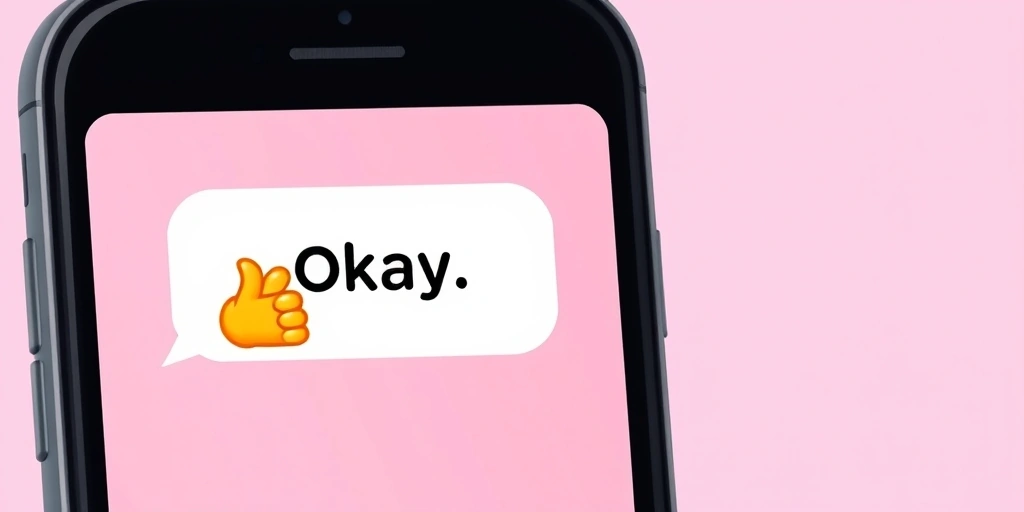
I was talking to a friend about this the other day, and she told me a story about planning a trip with a group. Someone suggested a change to the itinerary, and another person just replied "Okay." Cue the group chat anxiety. Was that a resentful "okay"? A disappointed one? A few minutes later, they followed up with "Okay! 👍 That works for me." The simple addition of the thumbs-up emoji completely dissolved the tension. It was a perfect example of how these little icons act as digital body language, bridging the gap when words feel heavy.
The Art of the Recovery Emoji
Sometimes, the silence happens after we've sent something. You hit send and immediately think, "Oh no, that could be read the wrong way." What do you do? Send another text explaining your first text? That often makes it more awkward.
Enter the recovery emoji. A single 🥲 or 😅 sent a minute later can be a masterstroke. It's a non-verbal nudge that says, "Hey, reread what I said with this feeling in mind." It's a gentle correction of tone without the clumsiness of a verbal correction. It acknowledges the potential for misinterpretation and offers a key. It's one of the most subtle and useful social tools we have in our digital toolkit.
This function of emojis—softening, clarifying, reassuring—is something we perform dozens of times a day without even thinking about it. We're constantly managing the emotional temperature of our digital spaces. A well-placed emoji can de-escalate a misunderstanding before it starts, or reinforce a connection with a shared feeling. It turns a transaction of information into a moment of human connection.
It's fascinating to consider how much emotional labor is done by these pictograms. They carry the weight of a wink, a sigh, a grin, or an eye-roll. They do the work of filling in the uncomfortable pauses, the beats of conversation that would naturally exist in person. In many ways, they are the punctuation marks of modern emotion.
Of course, it's not a perfect system. Emoji interpretation can vary by person, generation, and culture. But the intent is usually clear: to connect, to clarify, to add a layer of warmth to the cold medium of text. They are our best attempt to be fully human in a space that can feel strangely disembodied.
So the next time you feel that small knot of anxiety when a chat goes quiet, or you hesitate before sending a message, remember the power you hold at your fingertips. That little library of faces, objects, and symbols is more than just fun. It's a fundamental part of how we understand each other now. It's how we tell each other, "I'm here, I'm listening, and I mean this in the kindest way possible." And more often than we notice, that's exactly what gets us through the day.
For more thoughts on how we navigate these quiet moments, you might find this piece on how emojis ease our awkward digital silences really relatable. It's all part of the larger conversation about emoji and situation that shapes our daily digital lives.
📒 Related Blogs
More...When Emojis Go Rogue: How Group Chats Become Tone-Deaf Minefields
The Unspoken Magic: How Emojis Make Your Messages Feel Lighter Instantly
Decode Emojis: Uncover Hidden Meanings & Secret Emoji Language
Navigating Emotional Landmines: How Emojis Soften Awkward Digital Moments
The Slow Burn: How Emojis Quietly Create Awkwardness Over Time
The Neutral Ground: How Emojis Keep Work Emails Professional and Clear