The Emoji Drift: How Your Favorite Symbols Send Unintended Messages

Mar 16,2026
We’ve all been there. You send a quick text, punctuated with what you think is the perfect emoji—a friendly gesture, a touch of humor, a bit of warmth. Then, the reply comes back. It’s a little cold. A little confused. Or worse, it’s a completely different emotional tone than you aimed for. You re-read your message. The words seem fine. So what happened? Often, the culprit is that tiny, colorful character you thought was harmless.
It’s not about the obvious blunders, like sending a skull 💀 to express sympathy (unless you're talking to Gen Z, where it might mean 'dying of laughter'). It’s about the subtle, slow drift. The emoji that once felt universally positive can, over time and across different social circles, pick up new connotations. It starts to send signals you never put into it.
When Context is Everything
An emoji doesn't live in a vacuum. Its meaning is shaped by the conversation it's in, the relationship between the people texting, and, most powerfully, the cultural and generational context of the receiver. What feels like a playful nudge to you might read as passive-aggressive to someone else. A symbol of gratitude in one group chat might be a sign of sarcasm in another.
This is especially true in professional settings. That winking face 😉 you added to soften a request? To a new colleague or a client from a different corporate culture, it might not read as 'friendly and casual.' It could be misinterpreted as unprofessional, flirty, or even dismissive. The signal you sent was 'let's keep this light,' but the signal received was something else entirely. For more on professional pitfalls, our guide on when a simple emoji makes a big mess dives deeper.
[[emojilar_img1]]
Think about the folded hands emoji 🙏. For years, it was widely used as a 'prayer' or 'thank you' symbol in many Western contexts. But its primary meaning is a gesture of request, greeting, or gratitude in several Asian cultures. If you're thanking a Japanese business partner, it's perfectly appropriate. If you're using it to say 'praying for you' to a friend, that's also common. But the lines blur. Someone might use it to mean 'please' or 'I'm begging you' in a semi-serious, pleading way. The receiver, depending on their background, might see piety, politeness, or desperation. The same pixels, three different emotional landscapes.
The Generational Divide in Your Keyboard
Perhaps the fastest-moving current in the river of emoji meaning is the generational one. Platforms like TikTok and Twitter are accelerators, creating and spreading new uses for old symbols at lightning speed.
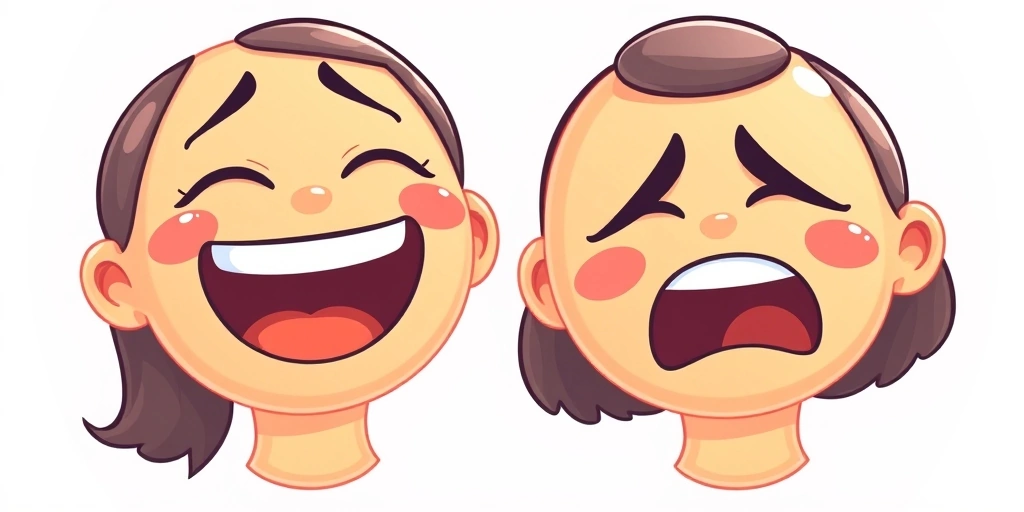
The crying-laughing emoji 😂 is a classic case. For Millennials and older Gen X, it was the ultimate stamp of genuine humor. But for many in Gen Z, it’s become 'cringe'—a marker of an older, try-hard sense of humor, sometimes even replaced by the skull 💀 or the sobbing face 😭 to indicate something is hilariously funny. Send a 😂 to a teen about a meme they shared, and your signal of 'I find this hilarious' might be received as 'My mom thinks this is funny.'
It goes beyond humor. The simple red heart ❤️ can feel intense and serious to younger users who parcel out affection with specific colored hearts (purple for friends, black for edgy aesthetics, blue for solidarity). The thumbs-up 👍, once a neutral sign of agreement, can now carry a whiff of dismissal or sarcasm, especially in certain online communities. You meant 'got it, thanks!' They read 'whatever, this conversation is over.'
When Cute Becomes Complicated
Even the most innocent-seeming emojis aren't safe. Take the smiling pile of poo 💩. It started as a silly, shocking joke. Then it became a way to call something 'bad' or 'crappy' in a lighthearted way. Now, in some circles, it can be used almost affectionately to describe a chaotic but endearing situation. The journey from literal waste to a term of endearment is a strange one, and being on the wrong point of that journey leads to confusion. We explore similar journeys in the emoji that said too much.
The blushing smiley 😊 is another minefield. Is it genuine shy pleasure? Is it a polite but non-committal response to a compliment you don't fully accept? Is it, as some read it, a slightly awkward, forced smile? The difference is microscopic but emotionally vast.
So, what do we do with this knowledge? We can't become emoji linguists, decoding every possible interpretation for every person we text. That would take the joy and speed right out of digital conversation. But we can develop a little empathy and awareness.
We can remember that the person on the other end is filtering our message through their own experiences, their own group chats, and their own slice of the internet. If a reaction seems off, maybe pause and consider the symbols, not just the words. When messaging someone new, or in a high-stakes situation, sometimes simplicity is best. A period can be powerful. A plain 'thank you' can be clearer than a bouquet of potentially misinterpreted icons.
Emojis are a living language, the most vibrant and visual one we've ever created for casual communication. And like any living language, it evolves, splinters, and surprises. The drift isn't a flaw; it's a feature of something that's truly alive and used by billions. The unintended signals aren't always mistakes—they're just reminders that connection, even in its most pixelated form, is beautifully, frustratingly human.
For more stories and insights into the world of emoji missteps and meanings, you can always browse our full collection on emoji mistakes and misuse.
📒 Related Blogs
More...The Emoji That Said Too Much: When Your Cute Symbol Sends the Wrong Vibe
Emoji Evolution: A Fascinating History of Digital Feelings & Communication
The Secret Power of Emojis: How Tiny Icons Shape How We See Each Other Online
The Secret Language of Reactions: How Emojis Shape Opinions Online
The Secret Language of Emojis: How Our Online Tribes Shape Every 😂 and 🥺
How Emoji Combinations Quietly Shape the Mood of Your Comments