The Secret Power of Emojis: How They Shape Our Feelings Online

Feb 28,2026
Think about the last time you got a text that was just plain words. Maybe it was a simple "okay" or "sounds good." How did it make you feel? A little cold? Uncertain? Now, picture that same message with a smiling face emoji at the end. Suddenly, it feels warmer, more agreeable, and definitely more friendly. That shift in feeling isn't random—it's psychology in action.
Emojis have become the digital world's body language. In face-to-face chats, we rely on tone of voice, facial expressions, and gestures to understand the full meaning behind someone's words. Online, where those cues are stripped away, emojis step in to fill the void. They don't just add flair; they actively guide our subconscious reactions, setting the emotional tone before our conscious mind even has a chance to catch up.
The Instant Emotional Primer
Our brains are wired for efficiency. We process visual information—like a tiny, colorful icon—incredibly fast, often before we've fully digested the text it accompanies. When you see a heart or a thumbs-up, your brain immediately registers a positive, affiliative signal. Conversely, a skull or a facepalm emoji primes you for frustration or humor, depending on the context.
This priming effect is powerful. It frames how we interpret everything that follows. A message that could be read as sarcastic or harsh becomes playful when paired with a winking face. A request feels less like a demand and more like a friendly ask when it ends with a pleading or smiling emoji. The emoji acts as a subconscious instruction manual, telling our emotional centers how to feel about the words we're reading.
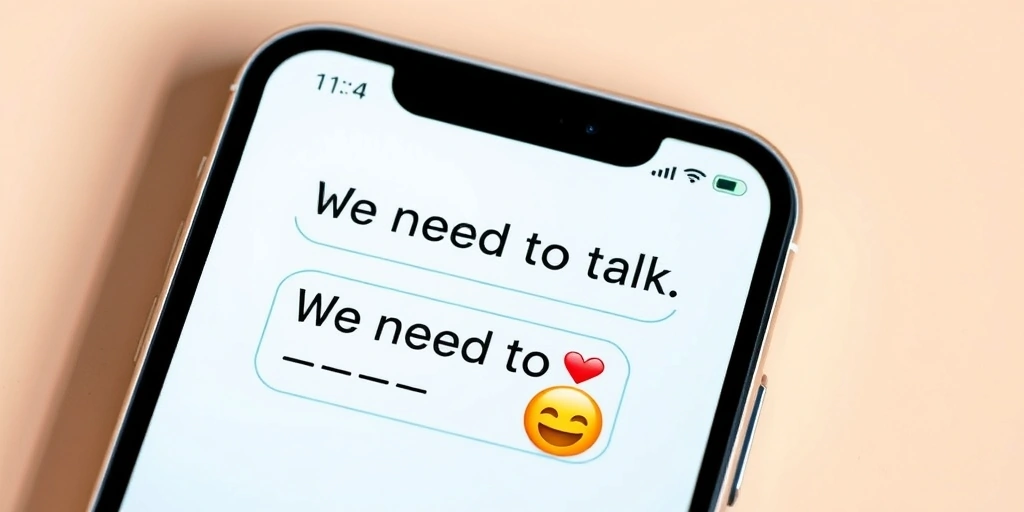
This is why choosing the "wrong" emoji can lead to such dramatic misunderstandings. That single grimacing face you meant to signal mild awkwardness might be read by your friend as intense disgust. Our brains latch onto that visual cue and build the narrative of the conversation around it. For a deeper dive into how these tiny symbols form a complex language, check out our post on the hidden language of emojis.
Building Connection and Reducing Ambiguity
Beyond priming, emojis serve a crucial social function: they build bridges of empathy and shared understanding. In a medium fraught with ambiguity, they reduce cognitive load. We don't have to spend mental energy wondering "Is she mad?" or "Is he joking?" The emoji provides a clear, if simplified, emotional data point.
This is especially vital in professional or new social contexts where the relational rules aren't yet established. A well-placed emoji can soften feedback, express gratitude genuinely, or signal collaborative spirit. It’s a low-risk, high-reward way to inject humanity into digital exchanges and foster a sense of psychological safety. You can explore more about how this speeds up our communication in our article on the mind's shortcut.
The Subconscious Dance of Sender and Receiver
The psychology works from both sides. When we choose an emoji, we're not just decorating a message; we're engaging in a form of emotional forecasting. We're predicting how our words might land and proactively trying to shape that reception. We think, "If I add this laughing emoji, they'll know I'm not being serious." This is an act of empathy and social calibration.
On the receiving end, our reaction is often visceral and immediate. That flutter of happiness from a heart reaction, the slight sting from an eye-roll emoji—these are real emotional responses triggered by a pictograph. They reinforce social bonds or, in negative cases, can create distance. This constant, low-level emotional exchange is what makes our digital conversations feel alive and relational.
So, the next time you tap that emoji keyboard, remember you're not just picking a cute icon. You're wielding a subtle psychological tool. You're setting a stage, guiding a reaction, and participating in the complex, subconscious dance of human connection—all with a single, tiny, powerful image. It’s a fascinating reminder of how we've adapted ancient social instincts to our modern, pixelated world. For more insights into the intersection of emojis and human behavior, browse our full collection in the emoji psychology category.
📒 Related Blogs
More...The Tiny Gesture That Makes Work Chats Feel Human
The Unspoken Rescue: How Emojis Save Us From Socially Awkward Moments
The Unspoken Rhythm: How Emojis Guide the Flow of Our Online Chats
The Slow Burn: How Emojis Quietly Create Awkwardness Over Time
The Hidden Language of Emoji Pairs in Your Social Media Comments