When Emojis Cause Confusion: How Group Chats Can Twist Your Intent

Jan 30,2026
We've all been there. You're in a lively group chat, the conversation is flowing, and you drop in what you think is the perfect emoji. It's meant to be supportive, funny, or just a simple acknowledgment. But then... silence. Or worse, someone replies with a question mark, or a completely different tone takes over. That sinking feeling hits: your emoji was misunderstood.
It's a uniquely modern form of social fumble. In one-on-one chats, we have more context. We know the person's mood, we can follow up quickly. But in a group, your single emoji is broadcast to an audience with different relationships, senses of humor, and reading styles. What you meant as a playful wink 😉 can be read as sarcastic. A thoughtful face 🤔 might come across as judgmental. The infamous crying-laughing emoji 😂 can either amplify a joke or, in a serious discussion, seem dismissive and insensitive.
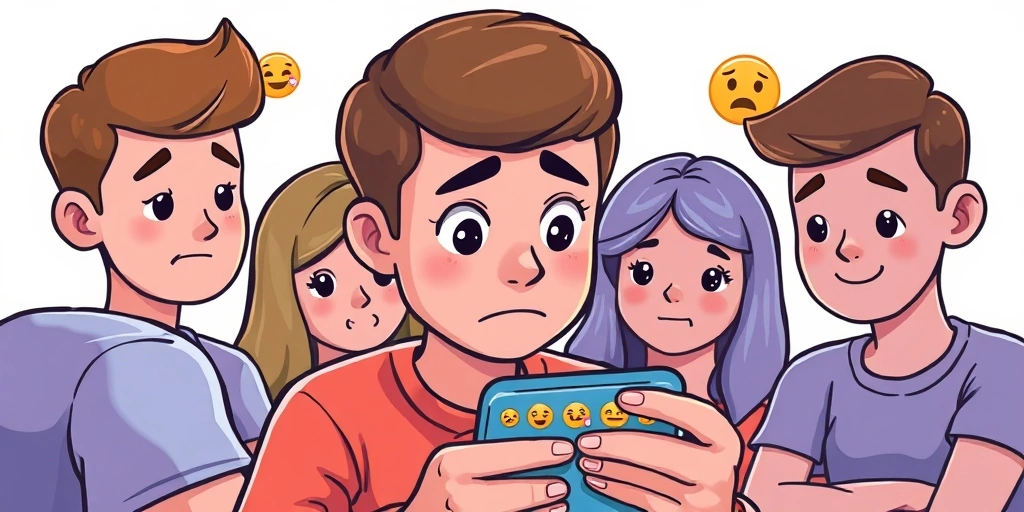
This divergence between intent and interpretation is at the heart of so many digital misunderstandings. You, the sender, are operating with a full internal script—the tone of your voice, your facial expression, your relationship with the topic. The receiver, however, only gets the cold, hard pixels of the emoji, filtered through their own experiences and the group's dynamic at that exact moment.
Consider the simple thumbs-up 👍. For many, it's a quick "got it" or "sounds good." But in some contexts, or to some people, it can feel curt, passive-aggressive, or like a conversation-ender. In a group setting, where others are writing full sentences, a lone thumbs-up from one person can stick out, its meaning becoming ambiguous. Was that agreement? Reluctant approval? Or are they just brushing off the conversation?
Why Group Dynamics Amplify the Problem
Group chats aren't just multiple one-on-one conversations happening at once. They create a new, complex social ecosystem. There's often an unspoken hierarchy, inside jokes, and varied levels of closeness between members. An emoji that's harmless between two close friends can land differently when their third friend, who isn't in on the same dynamic, sees it.
Furthermore, people read messages in groups at different times and out of context. Someone might scroll up, see your emoji reaction to a message from hours ago, and completely misinterpret the sequence of events. The delay between sending and various members reading it strips away the real-time, fluid nature of the conversation.

This is why it's so easy for emojis to miss the mark. They are rich with potential meaning but poor in specific, unambiguous communication. They require a shared cultural and contextual understanding that is often fragile in diverse group chats.
Navigating the Emoji Minefield
So, what can we do? The goal isn't to stop using emojis—they're wonderful for adding warmth and personality to text! The goal is to use them more mindfully in group settings.
First, consider the emotional temperature of the chat. Is the topic lighthearted or serious? If the discussion is sensitive, a stray emoji can derail it. Sometimes, words are simply safer. A quick "That's funny!" or "I agree" removes all ambiguity that a 😂 or a 👍 might carry.
Second, think about your audience. Do you know everyone in the group equally well? If there are acquaintances or colleagues mixed with close friends, opting for clearer communication helps include everyone and prevents private jokes (even unintentional ones) from forming via emoji.
Finally, don't be afraid to clarify! If you sense a misunderstanding, it's okay to follow up. A simple "Haha, I meant that in a good way!" or "Just to clarify my 😬 emoji—I'm nervously excited!" can smooth over any awkwardness. It shows you care about being understood.
These moments of confusion are a natural part of how our language evolves. Emojis are a powerful, but still young, form of expression. For more on the nuances of emoji communication, you can explore our thoughts on emoji awkwardness and other common pitfalls in the emoji mistakes & misuse category.
At the end of the day, a little empathy goes a long way. If someone's emoji seems off in the group chat, give them the benefit of the doubt. And when you're the one sending, take that extra half-second to see your message through the eyes of others. It makes our shared digital spaces a little warmer, and a lot less confusing, for everyone.
📒 Related Blogs
More...Unlock Clarity: How Emojis Transform Quick Chats from Confusing to Crystal Clear
Emoji Art and Design: Unlocking Creative Expressions Beyond Simple Text
The Quiet Power of Emojis: Boosting Confidence in Subtle Conversations
Cracking the Code: How Emojis Shape What We Really Mean Online 🤔
The Subtle Power: How Emojis Shape Professional Messages
The Quiet Language of Family: How a Simple Emoji Says 'I'm Here'